Final expense insurance is an affordable, permanent life insurance policy. Some people call it burial insurance or funeral insurance. It can help your family pay for costs that come after a death. The policy pays money to the person you choose. That person can use the money for funeral costs, cremation, burial, medical bills, debts, travel, or other needs.
Written By
Licensed & Reviewed
Aaron PolkAaron Polk founded Golden Shield Life Insurance after a 2007 accident showed him how fast a steady life can change. He is a licensed independent agent in Atlanta with a background in medical underwriting, and he compares 130+ insurance companies to find coverage that fits. Read more on LinkedIn
Every life insurance policy comes with a free look period, often up to 30 days depending on the insurance company and your state. If you change your mind during that time, you can return the policy for a full refund of the premiums you paid. Get your quote and review it with no risk.
Final Expense Buyer's Guide
Learn how final expense insurance works, what affects the cost, and whether it fits your needs.
How It Works. Understand final expense, burial, and funeral insurance, including what the coverage is commonly used for.
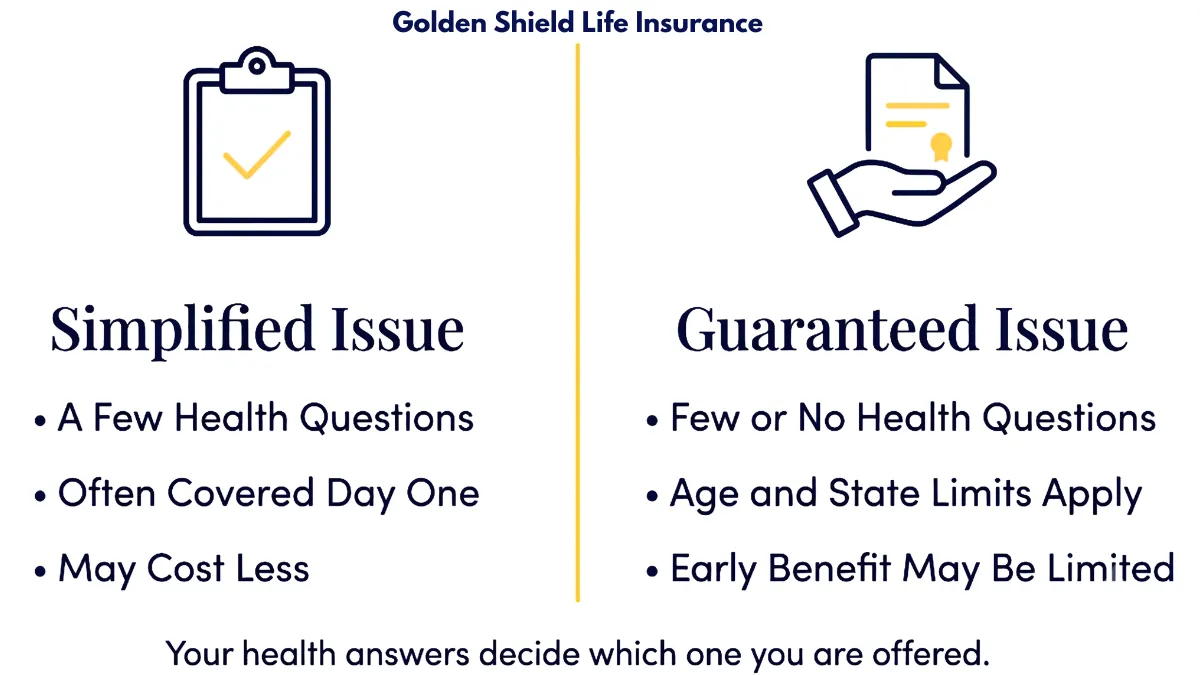
Coverage Options. Compare simplified issue and guaranteed issue policies, including possible waiting periods during the first few years.
What It Costs. See why age and health affect your premium, and why waiting can limit your options.
Pros and Cons. Review the benefits, limitations, and alternatives before choosing a policy.
Aaron Polk with his father, Ron.
Editor's Note
My father, Ron, is a U.S. Army Green Beret. Someone approached him with a final expense pitch and claimed to be with the VA. They had a website. They mailed him a business card. It looked real enough that he almost signed.
I traced the address and phone number. Neither belonged to the VA. Both led back to a scam, and I reported it to the state.
You should not have to hire a detective to buy honest coverage. That is why Golden Shield Life Insurance exists, and how we serve veterans, seniors, and families every day.
Before you sign anything:
Confirm the agent has an NPN (National Producer Number).
Never make a check payable to a person.
Pay premiums to the insurance company, usually by bank draft with your routing and account number, for your safety.
No cost, no obligation. No medical exam options may be available for qualified applicants.
What Is Final Expense Insurance?
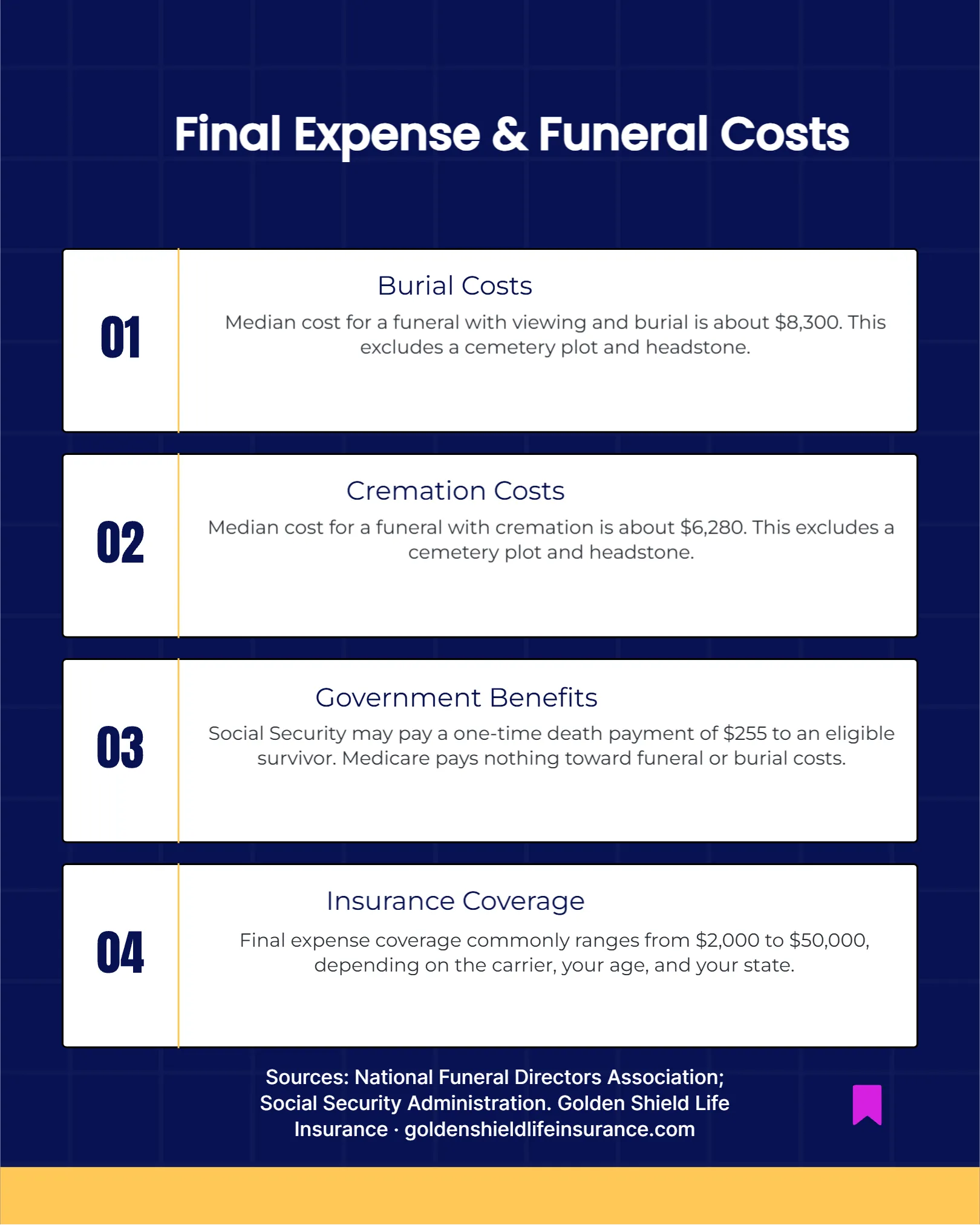
Final expense insurance, also called burial or funeral insurance, is a whole life policy with a permanent death benefit. It is meant to help cover end of life costs such as funeral services, burial services, medical balances, and small debts. Benefit amounts are often between about $2,000 and $50,000, depending on the carrier and your age.
You pay premiums
→
Coverage stays active
→
Beneficiary receives cash
Why People Buy Final Expense Insurance
Families often buy it so unexpected costs do not fall on their children. Here are six common reasons.
The middle price for a funeral with viewing and burial is about $8,300. With cremation it is about $6,280. Those come from the NFDA's most recent study, using 2023 numbers.1 Neither figure includes a cemetery plot or headstone.
Funeral & Burial
Pay for the service, casket, and plot.
Medical Bills
Pay off remaining bills so your family does not have to.
Credit Card Debt
Pay off balances so they do not come out of your estate.
No Medical Exam
Many policies skip the nurse visit.
Senior Coverage
Built for people who do not want to leave costs to family.
Level Premiums
Many policies use a premium that stays level once coverage begins.
A short form, usually with no medical exam. The company reviews it and makes an offer.
Coverage Begins
You pay premiums to keep it active.
Your Family Is Paid
They file a claim and receive the money.
What Are the Different Types of Final Expense Insurance?
What the Policy Pays in the Early Years
The company decides which policy you can get. The policy decides what your family gets paid, and when. There are two kinds.
Level benefit. Pays the full amount right away, for a covered cause of death.
Graded benefit. Pays less if you die of natural causes in the first years, often about two. After that it pays the full amount. Most pay in full from day one if you die in an accident. Many also give back the money you paid in, plus a little more.
How long that early period lasts, and how much money comes back, is different at every company. Ask which kind you are being offered before you apply.7
We look at your age and your health answers, then find the policies you can actually get and what each one costs. Once you have offers in hand, here is how to compare final expense insurance offers side by side.
Apply today and compare options. We cannot change the past with our health or our savings. But we can plan for the future.
Final Expense Insurance Policy Riders
A rider is an optional add-on that changes what a policy covers. Availability and age limits vary by insurance carrier, policy, and state.
Accidental Death
Can pay extra cash if death results from a covered accident.
Waiver of Premium
May pause your payments if you become totally disabled.
Children's Term
Can add coverage for a child, grandchild, or great-grandchild.
Hospital Benefit
May pay you daily cash for a covered hospital stay.
Cancer Benefit
Can pay you cash after a covered cancer diagnosis.
Living Benefits
Often included at no extra cost. Using it early lowers your family's payout.
Why Final Expense Insurance Costs More the Longer You Wait
Your age is part of the price. The same coverage usually costs more the longer you wait. And if a doctor finds something new, that can change which policies you can get.
Your age today. Price is set by your age, so applying sooner usually costs less than waiting.
Your health today. Something diagnosed next year can change which policies you can get.
It takes minutes. Most applications are short, and a medical exam is often not required.
Pros and Cons of Final Expense Insurance
Final expense insurance works well as a whole life insurance policy. Most policies lock in your rate for life, and the death benefit is paid as long as the policy is active, under the policy's terms.
Pros
It can last for life. As long as premiums are paid, the coverage does not expire at a certain age.
The price usually stays level. Many policies keep the same premium for life once coverage begins.
Smaller amounts that fit a fixed income. You can buy only what the funeral and final bills are likely to cost.
Often no medical exam. Many policies use health questions instead of a nurse visit.
Your family decides how to use the money. The beneficiary receives cash, not a funeral package.
Cons
It costs more per dollar of coverage. A healthy person can usually buy more coverage for the same money with term life insurance.
The amounts are small. It is built for final costs, not to replace an income or pay off a large mortgage.
Some policies pay less early on. Graded and guaranteed issue plans may pay only part of the benefit, or a refund of premiums, for a natural death in the first years.
It can lapse. If premiums stop, the coverage can end.
A final expense policy pays cash to your beneficiary, who can use it at any funeral home or for other bills.7
What Do You Need for a Final Expense Insurance Quote?
Identification. Social Security number and a driver's license or state ID.
Medical details. Current medications, physicians, and health history.
Beneficiaries. Full names, dates of birth, and contact details.
Insurance companies will not pay a benefit directly to a minor child. If you want money to reach a grandchild, name your estate or a trust instead, or speak with an attorney about how to set that up.
Do not cancel existing coverage until the new policy has been issued, reviewed, and accepted.6
How Does a Final Expense Policy Stay Active?
Paying the premium keeps the policy active. Many companies can draft it from your bank, and some let you match the date to your Social Security deposit. If you miss a payment, most life policies give you about 31 days to catch up. If you borrow against the policy, your family gets less.7
How Do You File a Final Expense Insurance Claim?
Call the insurance company. The claims number is printed on the policy.
Send a certified death certificate. The carrier will also send a short claim form to complete.
Call Golden Shield Life Insurance. We speak with the carrier directly and help keep the claim moving, at no cost to your family.
Approved benefits are paid to the named beneficiary. Death benefits are generally not subject to federal income tax, though exceptions can apply.2
Is Final Expense Insurance Right for You?
It may be a fit if:
You do not want funeral or medical bills to fall on your family.
You want coverage that lasts for life, not a term that may expire in retirement.
You prefer applying without a medical exam.
Savings, existing coverage, or veteran benefits are not already enough.
How much coverage to buy. Many families start with what a funeral or cremation costs in their area, then add final medical bills and small debts. That total, not the largest amount offered, is usually the right place to start.
Buying coverage for a parent. An adult child can help a parent shop, can pay the premium, and can be named the beneficiary. The parent still has to agree to the policy, answer the health questions, and sign the application.
Why government benefits may not be enough. Social Security may pay a one-time $255 lump sum to an eligible surviving spouse or child.3 Medicare provides no funeral or burial benefit. Some veterans may qualify for VA burial benefits, though eligibility rules apply.4
If final expense insurance is not the right fit for your budget or your situation, we would rather tell you. Every policy we place also includes a free burial planner, so your family knows your wishes.
Why Choose Golden Shield Life Insurance for Final Expense Coverage?
Would you hire someone without checking their reviews? Look at ours. Then talk to a person who is local, who will find what you actually qualify for, and who will still be here on the worst day of your family's life.
We listen first. We start with your situation, not with a policy we want to sell.
We shop it out. Comparing companies yourself means a separate application and separate health questions at each one. We do it in one sitting and show you the offers side by side, at no cost to you.
We are local and near you. Call, text, chat online, or stop by. You get a person, not a call center.
We know what a claim feels like. Every claim is a family in distress. We know, because we have lived it.
Compared Across Top-Rated Carriers
Call, compare, and apply today.
Every new policy includes a free burial guide and a free will.
Glen's Story
Union Worker (Police Officer)
Aaron is more than an agent, he's a persistent caring person who never gives up until he finds the policy which best fits you and your family needs.
Aaron is more than an agent, he's a persistent caring person who never gives up until he finds the policy which best fits you and your family needs. I met Aaron for the first time and instead of him offering to buy him lunch, I insisted on buying him lunch. His hard work will be a blessing to your needs because he really does care.
Glen's verified Google review, reprinted in full and unedited.
Testimonials reflect the experience of individual clients of Golden Shield Life Insurance. Coverage and rates vary by age, health history, state, and carrier underwriting.
FAQ about Final Expense Insurance
Is final expense insurance worth it?
Only if your end-of-life costs are not already covered. If savings or existing coverage already handle the funeral, medical bills, and debts, more coverage is generally unnecessary.
Is the $50,000 final expense benefit real?
Yes, though it depends on your age, health, and state. Several carriers offer face amounts up to $50,000, but limits and health questions vary by insurer.
How much is final expense insurance per month?
Price scales with the benefit amount, and coverage usually tops out around $50,000.
$5,000: roughly $20 to $45 a month
$10,000: roughly $30 to $100 a month
$20,000 and up: roughly $60 to $200 or more a month
Your age, health, sex, and tobacco use set the final number. These are ranges, not a quote.
What is the best final expense insurance company?
There is no single best company, because every person has different health and budget needs.
Golden Shield Life Insurance is an independent agency, not a single carrier. That means we do not work for one big insurance company. We shop around for you. When you call or visit our Atlanta office, a licensed agent compares multiple companies side by side to find the strongest offer you qualify for at your exact age and health history.
Our help is free to you. Agents are paid by the carrier, so you generally pay the same price as buying direct.
Is burial insurance the same as final expense insurance?
Yes. Burial insurance, funeral insurance, and final expense insurance are different names for the same small whole life policy built to cover end-of-life costs.
What is the difference between level, graded, and modified benefits?
It decides what your family is paid if you die in the first few policy years.
Level. Pays the full benefit from the start, for a covered death.
Graded. Pays part of the benefit early, then the full amount.
Modified. Returns your premiums plus stated interest for a natural death during an initial period.
The amounts and time periods differ by carrier. Ask which one you are being offered before you apply.
Every family deserves a shield, and every person deserves an honest explanation before making a decision.
This page is about you and the people you love. When the time comes, your family should get a person who answers the phone, not a runaround. That is why Golden Shield Life Insurance gives you:
U.S. Federal Trade Commission · Updated March 2024
The FTC Funeral Rule gives you the right to see itemized prices before you agree to anything. This guide breaks a funeral bill into its three parts, the basic services fee everyone pays, charges for optional goods and services, and cash advances the funeral home pays to outside vendors on your behalf. It also lists what a provider may not tell you, including that embalming is required by law, that state law requires a casket for a direct cremation, or that a vault or a particular casket will preserve remains indefinitely. None of those are true. The article closes with a printable checklist you can take to several funeral homes and compare line by line, which is the clearest way to see what a service in your area actually costs before you decide how much coverage you need.
Founder & CEO and Licensed Life Insurance Agent and Broker, Golden Shield Life Insurance · NPN 21216745 · Georgia Agency License 242517
Aaron founded Golden Shield Life Insurance after a 2007 accident showed him how fast a steady life can change. He compares more than 130 carriers to help families find honest coverage, with a focus on older applicants and people other agents pass over.
How this guide was made: Written by a licensed agent from first-hand casework, not compiled from other insurance websites. Cost figures, tax treatment, government benefits, and consumer rights are checked against the numbered public sources below, each of which is linked so you can read it yourself. Carrier-specific details such as issue ages, benefit schedules, and rates come from current carrier materials and are confirmed at the time of quoting rather than stated as fixed on this page.
Last reviewed: . This page is reviewed and updated as products, funeral costs, tax rules, and carrier practices change.
Free Printable Resources
Print or download our free Burial & Cremation Guide, Final Wishes planner, Free Will and Family Planner, Veterans Will & Burial Kit, and more. No sign-up or purchase required.
Brochures are published by each insurance company and describe its own products. Availability, benefits, and pricing vary by state and are governed by the policy you receive.
Facts on This Page Are Supported By
1National Funeral Directors Association. General Price List Study. Supports the national median costs cited for a funeral with viewing and burial and for a funeral with cremation, neither of which includes a cemetery plot or headstone. Accessed July 2026. nfda.org/news/statistics
2Internal Revenue Service. "Life Insurance & Disability Insurance Proceeds" and Publication 525, Taxable and Nontaxable Income. Supports the general federal income tax treatment of death benefits paid to a named beneficiary, including the exceptions that can apply. Accessed July 2026. irs.gov FAQ · irs.gov/publications/p525
3Social Security Administration. Survivors benefits and the lump-sum death payment. Supports the one-time payment that may go to an eligible surviving spouse or child, and the actuarial basis for age-based pricing. Accessed July 2026. ssa.gov survivors · actuarial life table
4U.S. Department of Veterans Affairs. Burials and Memorials. Supports veteran burial allowances, national cemetery plots, and government-furnished headstones or markers, all subject to eligibility rules. Accessed July 2026. va.gov/burials-memorials
5Federal Trade Commission. "Funeral Costs and Pricing Checklist" and "The FTC Funeral Rule." Supports your right to itemized pricing and the limits on what a funeral provider may claim about embalming, caskets, and burial vaults. Updated March 2024. pricing checklist · funeral rule
6Georgia Office of Insurance and Safety Fire Commissioner. "Life Insurance" consumer resource. Supports the guidance not to cancel existing coverage until a new policy has been issued and reviewed, and the state's direction to weigh final expenses and outstanding debts when deciding how much coverage to buy. Accessed July 2026. oci.georgia.gov
7NAIC, National Association of Insurance Commissioners. Consumer guidance on life insurance and annuities. Supports the whole life and cash value framework behind final expense, the definitions of accelerated death benefit and other riders, the guidance on weighing coverage against savings and existing obligations, and the point that premiums are generally the same whether a policy is bought through an agent or directly. Accessed July 2026. content.naic.org consumer guide · life insurance roadmap
8NAIC Life Insurance Policy Locator. A free national tool that helps families search for a deceased relative's lost life insurance policy and connect with unclaimed death benefits. There is no cost to use it and no need to contact us first. Accessed July 2026. eapps.naic.org life policy locator
9AM Best. Insurer financial-strength rating lookup. Supports checking whether a carrier is rated and able to pay claims before you apply. Accessed July 2026. ambest.com
10National Funeral Directors Association. 2025 Cremation & Burial Report and 2023 General Price List Study. Supports the projected 2025 U.S. cremation rate of 63.4% against a burial rate of 31.6%, and the median cost of a funeral with cremation. Accessed November 2026. NFDA research and information · nfda.org statistics
Disclaimers
National funeral and cremation costs are based on published NFDA research. Actual funeral expenses vary by location, provider, and the services chosen.
Cremation insurance is typically sold as final expense life insurance. Premiums and benefits vary by age, health, insurance company, and coverage terms.
Golden Shield Life Insurance does not guarantee approval, pricing, or benefit eligibility.
Prices, who can qualify, and which policies are offered are different at every company and in every state.
Riders are not on every policy and some cost extra. Amounts, ages, and terms are different at every company and in every state. Guaranteed issue plans generally do not offer riders at all. Hospital and cancer benefits are usually paid to you in addition to the death benefit rather than out of it. Using a living benefit early lowers the death benefit and any cash value, it is not long-term care insurance, and it may affect Medicaid or other government benefits. Ask which riders a company offers, and what each one does, before you apply.
Outbound links are provided for reference. Golden Shield Life Insurance does not control and is not responsible for third-party content, including any sponsorships or advertising those sites carry.
Important Information
Policy Disclosure
The final expense, whole life, and term products discussed on this page are private individual life insurance policies. They are primary life insurance coverage. They are not supplemental health insurance, hospital indemnity coverage, major medical insurance, or a prepaid funeral contract. A policy pays a cash death benefit to the beneficiaries you name, who decide how the money is used.
About Our Agency
Golden Shield Life Insurance is an independent life insurance agency and brokerage based in Atlanta, Georgia. We are not an insurance company and we do not underwrite, issue, or administer policies. Every policy is underwritten and issued by a third-party insurance carrier licensed in the state where it is sold, and all benefits are paid by that carrier under the terms of its contract.
There is no fee for our services. Licensed agents are compensated by the issuing carrier when a policy is placed.
Availability and Eligibility
Coverage amounts, issue ages, premiums, riders, benefit schedules, and product availability vary by carrier, by plan, and by state. Many final expense products are written for applicants in later adulthood, though the minimum and maximum issue ages differ by company and by state.
Applying does not guarantee approval. Eligibility depends on your age, health history, state of residence, and each carrier's underwriting rules. Some applicants may not qualify for a given plan or for any plan.
Benefit Schedules
Final expense policies are issued under different benefit schedules, and the schedule determines what is paid if death occurs early in the policy.
Level. Pays the full death benefit for a covered death from the policy's effective date.
Graded. Pays a reduced portion of the death benefit for a non-accidental death during an initial period, then the full amount.
Modified. Returns premiums paid plus stated interest, or pays a reduced amount, for a non-accidental death during an initial period.
The length of the initial period, the portion payable, and any interest rate are set by the carrier and stated in the policy. Read the benefit schedule in your contract before you accept coverage.
Limitations and Exclusions
All life insurance policies and riders contain limitations, exclusions, and a contestability period during which the carrier may review the application for material misstatements. Terms differ by carrier and by state. Causes of death that are commonly limited or excluded, particularly under accidental death benefits and optional riders, include:
Death by suicide within an initial period after the effective date, for which many contracts limit payment to a return of premiums paid, less any policy loan balance
Intentionally self-inflicted injury
War, an act of war, or participation in a riot or insurrection
Committing or attempting to commit a felony, or participation in an illegal occupation
Illness, disease, bodily infirmity, or medical or surgical treatment of them, where an accidental death benefit is concerned
Aviation other than as a fare-paying passenger, including experimental and military aircraft
Certain high-risk activities and motorsports
Voluntary use of a drug, poison, or gas other than a medication taken as prescribed by a physician
This list is illustrative and is not the complete set of limitations in any policy. The exclusions that apply to you are the ones printed in your contract and rider forms.
Riders and Living Benefits
Riders are optional and are not available on every policy or in every state. Some are included at no additional premium and some cost extra. Benefit amounts, qualifying conditions, and age limits are set by the carrier.
An accelerated death benefit, sometimes called a living benefit, pays part of the death benefit early when a qualifying condition is met. Taking one reduces the death benefit left for your beneficiaries and reduces any cash value. It is not long-term care insurance and it is not a substitute for one.
Taxes and Public Assistance
Death benefits paid to a named beneficiary are generally not subject to federal income tax, though exceptions apply. Accelerated death benefits may be taxable and may not receive the same tax treatment as other benefits.
Receiving an accelerated death benefit, or holding cash value, may affect eligibility for Medicaid, Supplemental Security Income, or other need-based public assistance programs. Golden Shield Life Insurance does not provide tax or legal advice. Speak with a qualified tax professional or attorney about your own situation.
Policy Values and Loans
Permanent policies may build cash value over time. Cash value growth is generally slow in the early policy years and is set by the contract.
Policy loans and withdrawals reduce the death benefit and any cash surrender value, may cause a policy to lapse, and may have tax consequences. Unpaid loan balances and interest are subtracted from the amount paid to your beneficiaries.
Keeping Coverage in Force
A policy stays active as long as required premiums are paid. Most life policies include a grace period for a missed payment before coverage ends. If a policy lapses, reinstatement is not guaranteed and may require new health questions.
Do not cancel an existing policy until a new policy has been issued, delivered, and reviewed. Most policies include a free look period during which you may return the contract for a refund under the policy and state rules.
This page is a general product overview for educational purposes. It is not a contract, not an offer of coverage, and not financial, legal, or tax advice. Complete benefits, definitions, waiting periods, limitations, and exclusions are governed solely by the policy and rider forms issued by the underwriting carrier. Rates and figures shown anywhere on this page are illustrative and are not a quote. Coverage is not available in all states.
Final Expense Insurance Terminology
Final Expense Insurance: A smaller whole life policy commonly used to help cover funeral, burial, cremation, medical bills, or other end-of-life expenses.
Burial Insurance: Another name commonly used for final expense insurance.
Face Amount: The amount of life insurance listed in the policy, such as $10,000, $25,000, or $50,000.
Death Benefit: The amount the insurer pays to the beneficiary when a covered death occurs.
Beneficiary: The person, people, or organization chosen to receive the death benefit.
Premium: The amount paid monthly, quarterly, or annually to keep the policy active.
Level Benefit: Coverage that may pay the full death benefit from the policy's effective date for a covered death, subject to the contract.
Graded Benefit: Coverage that pays a limited portion of the death benefit during the first policy years before the full benefit becomes available.
Modified Benefit: Coverage that may return premiums plus stated interest, or pay a reduced benefit, for natural death during an initial period.
Guaranteed Issue: A policy type that generally does not require health questions or a medical exam, but often includes an early natural-death benefit limitation.
Simplified Issue: Underwriting based mainly on health questions, prescription history, and available consumer or medical records, usually without a physical exam.
Waiting Period: The initial period during which the full benefit for natural death may not yet be payable.
Natural Death: A death caused by illness, disease, or age rather than an accident.
Accidental Death: A death caused by a qualifying accident, subject to the policy's definitions and exclusions.
Cash Value: Money that may accumulate inside a permanent final expense policy over time.
Contestability Period: The period when the insurer may review the application for material errors or misrepresentations after a claim.
Grace Period: Additional time to pay an overdue premium before the policy may lapse.
Lapse: When coverage ends because required premiums were not paid or policy requirements were not maintained.
Free Look Period: A limited period to review the policy and return it for a refund under the policy and state rules.
Licensed in Georgia and additional states · Georgia Agency License 242517 · NPN 21216745 Golden Shield Life Insurance · 1954 Airport Rd, Atlanta, GA 30341 · (678) 884-4653
How can we help?
Hi, welcome to Golden Shield Life Insurance. What would you like to do?
 Aaron PolkAaron Polk founded Golden Shield Life Insurance after a 2007 accident showed him how fast a steady life can change. He is a licensed independent agent in Atlanta with a background in medical underwriting, and he compares 130+ insurance companies to find coverage that fits. Read more on LinkedIn