No Medical Exam Term Life Insurance

No-exam term life insurance lets you skip the traditional physical, blood and urine tests.

Couple at home reviewing term life insurance options on laptop and phone

Insurers use your prescription history and health questionnaire to review your application in hours or days instead of weeks. Choose basic death benefit coverage, or add living benefits that give you access to cash during a serious illness.

Understanding what is included matters more than price alone.
Written byAaron Polk
Founder & CEO, Golden Shield Life Insurance
National Medical Underwriter & Licensed Insurance Broker
UpdatedNovember 11, 2026

Key Takeaways

  • Digital underwriting can mean a decision in minutes. Instead of scheduling a medical exam, the carrier reviews your application answers and digital records. Many healthy applicants get a fast decision without needles or lab work.
  • Your rate depends on your risk profile. Age, health class, coverage amount, term length and tobacco use all affect your quote. Comparing carriers can save you hundreds per year because each company weighs risk differently.
  • Living benefits protect more than just death. Some term policies include optional living benefits for critical illness, chronic conditions or terminal diagnosis, so you may access part of your death benefit while you are alive if you qualify.
  • Conversion options protect your future choices. A conversion option lets you change to permanent coverage later without new medical underwriting, within the limits your policy sets.
  • Coverage sized to your mortgage and income makes it real. The right death benefit can help your family keep the house and cover living expenses if you pass away.
  • Compare the policy, not just the price. The lowest monthly payment may not offer the best protection. Review term length, conversion options, living benefits, riders and underwriting rules before applying.
No Exam Term Life Insurance, 2026 Guide

What Is No Medical Exam Term Life Insurance?

No medical exam term life insurance can provide high coverage amounts without a physical exam, blood draw or needles. Instead of a doctor’s visit, insurers use accelerated underwriting to check your health history through digital records.

How It Works

Insurers review your Medical Information Bureau (MIB) record along with prescription and driving records. The MIB is an industry exchange that stores coded information from previous insurance applications to help prevent fraud and confirm the medical history you report.

Key Advantages

  • Fast decisions. Healthy applicants can often get a decision in minutes or days, not weeks.
  • Competitive pricing. For applicants who qualify, no-exam rates are often close to traditional exam rates. Some carriers charge the same.
  • Level premiums. With level term, your premium stays the same for the full term, commonly 10 to 30 years, even if your health changes.
  • High limits. Many carriers offer no-exam term coverage from $500,000 to $3 million, and some, such as Banner Life, go up to $4 million for qualified applicants.

Expert Comparison With Golden Shield Life Insurance

Every insurer’s underwriting rules are different. A decline at one carrier can be an approval at another. At Golden Shield Life Insurance, we compare qualifying options to help you avoid being sent to a medical exam when another carrier would not require one. Our licensed agents review the disclosures and optional riders so your life insurance fits your family’s goals.

Know What You’re Buying

No Medical Exam Is the Underwriting Method, Term Is the Product

“No medical exam” is not a type of life insurance. It is how the insurance company reviews your application. The product you are buying is term life insurance, coverage designed to protect your family for a set number of years.

Why This Distinction Matters

Many websites lump term, whole life, final expense and other policies together under “no exam life insurance.” That creates confusion because each product works differently, costs differently and covers you for a different length of time. Knowing whether you are comparing the underwriting process or the policy type helps you avoid overpaying.

How No Exam Underwriting Works

  • Accelerated underwriting. Insurers use automated rules and digital records (prescription history, medical information and driving reports) to review healthy applicants quickly, without a physical exam or blood draw.
  • Simplified issue term life. You answer detailed health questions but skip lab work and in-person exams. Decisions often arrive within days.

What This Means for Your Quote

A no-exam final expense policy might cost $100 or more per month for $10,000 of coverage. A no-exam term policy might cost around $35 per month for $500,000 for a healthy younger applicant. Both skip the exam, but only one is term life insurance. We compare the underwriting options you qualify for to match you with a fast decision and a competitive rate.

How It Works

How No Medical Exam Term Life Insurance Works

Accelerated underwriting reviews your application using digital data instead of a medical exam. Insurers check prescription history, MIB reports, driving records and public records to confirm your answers.
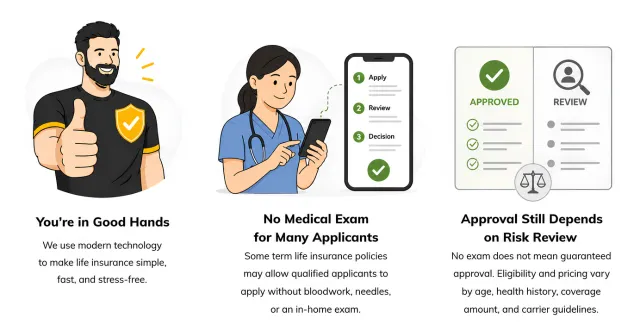
Accelerated underwriting process: licensed agent support, no medical exam for qualified applicants, approval based on risk review

Traditional vs. No-Exam Term Life

With traditional term life insurance, the carrier may require a medical exam before making a decision. With no-exam term life insurance, the carrier usually relies on digital underwriting instead, which may include:

  • Your health questionnaire
  • Prescription history
  • Motor vehicle reports
  • Prior insurance application data and MIB information
  • Public records

Decision Timeline

For healthy applicants, the process can be fast, and some people receive a decision in minutes. Others are sent to manual review if the carrier sees something that needs a closer look. That does not always mean denial. It may simply mean the insurer wants more information before approving the policy.

How the Process Works

  1. The application. You complete an online health and lifestyle questionnaire.
  2. Database checks. The insurance company checks third-party databases, such as the MIB, motor vehicle records and pharmacy records, to confirm your answers.
  3. The decision. If everything lines up, you may be approved. If not, the carrier may ask for a traditional medical exam or records from your doctor (an attending physician statement).

What Insurance Companies Look For When You Apply for Term Life Insurance

Insurance companies review specific health, lifestyle and financial factors to set your premium:

  • Age and sex: younger applicants and women usually pay less because, on average, they live longer.
  • Medical and family history: chronic conditions and early illnesses in close relatives are key review points.
  • Height and weight: your build affects your health class, and a high BMI can raise your premium.
  • Tobacco use: smokers often pay two to three times more than nonsmokers.
  • Risky hobbies: skydiving, rock climbing, scuba diving or private flying can raise rates or lead to exclusions.
  • Occupation: some higher-risk jobs can affect your rate.
  • Driving record: DUIs, speeding tickets and license suspensions can raise your rate.
  • Finances: income and debts help the insurer confirm your coverage amount is reasonable.

Conditions That Can Limit No-Exam Approval

Beyond the standard review, some situations may limit coverage, raise your premium or lead to a decline:

  • Serious health conditions: diabetes, heart disease, cancer history and similar conditions can mean higher premiums or lower limits.
  • High BMI: a very high BMI usually triggers further review and may lead to a decline.
  • Uncontrolled blood pressure: blood pressure controlled with medication is usually insurable. Untreated or uncontrolled pressure may not be.
  • Heavy alcohol use: frequent heavy drinking can raise premiums or lead to a decline.
  • Drug use: use of illegal drugs usually leads to a decline. Rules for marijuana vary by carrier.
  • Travel plans: planned travel to dangerous regions may lead to restrictions or a decline.

Having one of these conditions does not automatically mean you cannot get coverage. Your options may be narrower and your premium higher, but other carriers and coverage types may still be available. Some carriers now consider applicants with conditions, such as well-managed HIV, that once made coverage very difficult.

The bottom line: be honest and consistent on your application. False or incomplete information can delay approval, change your rate or cause problems with a claim later.

Term Life Insurance Rates With No Medical Exam

A $500,000 no-exam term life insurance policy often costs between $15 and $120 per month, depending on your age and health. No-exam coverage can cost slightly more than a fully underwritten policy, but for many people the speed is worth it.

Key Cost Drivers

  • Age and term: rates rise as you age. A 10-year term is usually the lowest cost; a 30-year term locks in your rate longer but costs more each month.
  • Health class: your class (for example Preferred Plus or Standard) depends on your history. Tobacco use can double or triple your premium.
  • Coverage amount: your rate scales with the death benefit.
  • Underwriting path: accelerated underwriting can price like traditional coverage for healthy applicants, while simplified issue usually costs more.

Estimated Monthly Rates ($500,000, 20-Year Term)

AgeCoverageEstimated Monthly Range
30$500,000$15–$30
40$500,000$25–$55
50$500,000$55–$120

These figures are examples for healthy nonsmokers, not quotes. Actual rates depend on your health, the carrier and your state.

How to Lower Your No-Exam Term Life Insurance Rate

  1. Compare quotes from at least three carriers. No-exam rates for the same person can vary widely from one company to another.
  2. Apply as young as possible. Rates rise with age, so locking in sooner keeps your premium lower for the full term.
  3. Answer health questions accurately. Insurers verify prescription and driving records, and inaccurate answers can lead to a denied claim or a cancelled policy.
  4. Buy the coverage you need. Match your death benefit to your income, debts and the people who depend on you. Contact us to talk through the right amount.
  5. Quit tobacco before you apply. Many carriers want 12 months tobacco-free before they rate you as a nonsmoker.

Term Life Insurance With Living Benefits

Most term life insurance focuses on the death benefit. Many policies also offer optional living benefits that let you use part of the death benefit early if you face a serious illness.

  • Chronic illness rider: early access to part of your death benefit if you cannot perform basic daily activities on your own, for example because of advanced Alzheimer’s.
  • Critical illness rider: a payout if you are diagnosed with a covered condition such as a heart attack, stroke or cancer, so you can focus on recovery instead of bills.
  • Terminal illness rider: if your doctor expects you to live 12 to 24 months or less (depending on the policy), you can access part of your death benefit for medical costs or final wishes.
  • Conversion option: lets you change your term policy to permanent coverage later without new medical underwriting, within the policy’s time limits.

Not every term policy includes these riders. Some low-cost policies pay a death benefit only. Always check which riders are included or available at extra cost.

For broader protection, you can pair term life with income protection insurance, including cancer, disability, accident and hospital indemnity coverage.

No-Exam Term vs. Traditional Term Life Insurance

Both paths are legitimate. No-exam coverage can be in place within days. Traditional coverage requires a medical exam but can cost less for very healthy applicants who qualify for the best rates. See example costs side by side.

How Much Coverage Do You Need?

A common starting point is 10 to 15 times your yearly income, then adjust for your mortgage, debts, your children’s education and the savings you already have. The NAIC Life Insurance Buyer’s Guide suggests starting with who depends on you and what they would need to pay.

The examples below are estimates for healthy nonsmokers, not quotes. Your actual rate depends on underwriting.

Age 30: $900,000 Coverage

No-Exam Path

Decision: 1–2 days · health questionnaire and digital records

10-Year Term
$28–$45/mo
Total: $3,360–$5,400
20-Year Term
$36–$58/mo
Total: $8,640–$13,920
30-Year Term
$48–$72/mo
Total: $17,280–$25,920

Traditional Path (Preferred Plus)

Decision: 4–5 weeks · medical exam and underwriting

10-Year Term
$18–$28/mo
Total: $2,160–$3,360
20-Year Term
$20–$32/mo
Total: $4,800–$7,680
30-Year Term
$28–$45/mo
Total: $10,080–$16,200

Estimated 30-year difference: $7,200–$9,720

Age 40: $1,200,000 Coverage

No-Exam Path

Decision: 1–2 days · health questionnaire and digital records

10-Year Term
$42–$60/mo
Total: $5,040–$7,200
20-Year Term
$54–$84/mo
Total: $12,960–$20,160
30-Year Term
$72–$108/mo
Total: $25,920–$38,880

Traditional Path (Preferred Plus)

Decision: 4–5 weeks · medical exam and underwriting

10-Year Term
$28–$38/mo
Total: $3,360–$4,560
20-Year Term
$38–$52/mo
Total: $9,120–$12,480
30-Year Term
$50–$72/mo
Total: $18,000–$25,920

Estimated 30-year difference: $7,920–$12,960

Age 50: $900,000 Coverage

No-Exam Path

Decision: 1–2 days · health questionnaire and digital records

10-Year Term
$80–$110/mo
Total: $9,600–$13,200
20-Year Term
$120–$160/mo
Total: $28,800–$38,400
30-Year Term
$165–$220/mo
Total: $59,400–$79,200

Traditional Path (Preferred Plus)

Decision: 4–5 weeks · medical exam and underwriting

10-Year Term
$55–$75/mo
Total: $6,600–$9,000
20-Year Term
$78–$110/mo
Total: $18,720–$26,400
30-Year Term
$105–$150/mo
Total: $37,800–$54,000

Estimated 30-year difference: $21,600–$25,200

Is No Exam Term Life Insurance Right for You?

No-exam life insurance works best for healthy applicants who want speed. Older applicants and people with health conditions can still qualify, but they may see higher premiums and lower coverage limits.

  • Healthy adults: under about age 60 with no major illnesses, looking for $500,000 or more without an exam.
  • Managed conditions: controlled blood pressure or cholesterol. Many carriers approve stable, treated conditions without an exam.
  • Busy professionals: tight schedules, a fear of needles, or a need for coverage in days instead of weeks.
  • Older applicants: people up to about age 80 can often qualify for smaller policies, usually at higher cost and lower limits.

Every carrier uses different underwriting rules. If one company declines you, another may approve you. Having your medication list and doctor’s information ready speeds up the process.

How to Compare No-Exam Term Life Insurance Quotes

Comparing quotes is not just about price. Ask yourself: could your family keep up with the mortgage, debts and groceries if you were seriously ill or passed away? Do you need coverage today, or can you wait a few days to save money over the life of the policy?

Instant Decision

Coverage decided in minutes. Best if you need insurance today, for example for a loan requirement. You may pay more for that speed.

24 to 48 Hour Comparison

Comparing carriers for a day or two can find lower rates or better features. Saving $10 to $20 a month adds up to thousands over 30 years.

Living Benefits vs. Death Benefit Only

The lowest quotes are often death benefit only, which means they pay only when you pass away. If you want a safety net while you are sick, look for living benefits.

The Cost of Speed

Some instant-decision platforms do not explain that fast approval can cost more over the life of the policy. The same coverage from another carrier, approved in a day or two, may cost less over 20 or 30 years. Either way, check the carrier’s AM Best rating so you know it is financially strong.

Common Mistakes When Choosing Coverage

  • Comparing price only: the cheapest policy may have fewer living benefits, less flexibility or limited conversion options.
  • Assuming “no exam” means automatic approval: you still answer health questions and authorize record checks, and dishonest or missing answers can lead to a denied claim.
  • Choosing death benefit only without thinking it through: if you survive an illness but cannot work, living benefits can help with recovery costs.
  • Underestimating your coverage need: add up your mortgage, debts and education goals. If one carrier caps no-exam coverage too low, another may offer more.
  • Ignoring conversion options: without one, you may not be able to switch to permanent coverage later if your health changes.
  • Skipping the financial strength check: look for an AM Best rating of A- or better.

The best choice depends on benefits, fine print and rates, not just the monthly price. Compare quotes across multiple carriers in minutes.

How to Apply Online

Many people can finish a no-exam application in about 10 to 20 minutes.

  1. Choose your no-exam path. Accelerated underwriting uses database checks and suits healthy applicants, often ages 18 to 60. Simplified issue relies on health questions and can work with minor health history.
  2. Gather your information. Have your Social Security number, driver’s license number and address; your medications and doctor’s contact information; and your income and beneficiary details.
  3. Complete the application and give consent. You answer medical and lifestyle questions and authorize the carrier to check prescription and motor vehicle records.
  4. Get your decision. Results usually come one of three ways: an automated decision in minutes, a same-day review by an underwriter, or a longer review if records are missing or complex.
  5. E-sign and activate. Review the policy offer, e-sign and set up your first premium. Coverage starts on the policy’s effective date, which usually requires the policy to be issued and accepted and the first premium to be paid.

Frequently Asked Questions

Can I get term life insurance without a medical exam?

Yes. Many carriers offer no-exam term life insurance through accelerated underwriting or simplified issue. No-exam does not mean guaranteed approval. The insurance company still reviews your health questions, prescription history and other records, and it may ask for an exam or your doctor’s records.

Can I get $1 million of term life insurance without a medical exam?

Often, yes, if you are healthy and within the carrier’s age limits. Many carriers offer no-exam term coverage from $500,000 to $3 million, and some, such as Banner Life, go up to $4 million for qualified applicants.

How much is $500,000 of no-exam term life insurance?

For a healthy nonsmoker, a $500,000, 20-year policy often costs about $15 to $30 a month at age 30, $25 to $55 at age 40 and $55 to $120 at age 50. These are estimates, not quotes.

Can I get a 20-year term policy without bloodwork?

Yes. Accelerated underwriting can approve 10, 15, 20 and 30-year term policies without blood or urine tests for qualified applicants.

Which insurance companies offer no-exam term life insurance?

Many carriers do, including Banner Life, Mutual of Omaha and Fidelity Life. Each sets its own age limits, coverage limits and health rules, which is why comparing carriers matters.

Can I get no-exam term life insurance after age 50?

Yes. Many carriers offer no-exam term coverage into your 50s and 60s, though coverage limits are usually lower and rates are higher than for younger applicants.

What if I have diabetes?

Well-controlled type 2 diabetes does not always rule out no-exam coverage. Your options depend on your A1C, medications and any complications. Some applicants qualify without an exam, while others get better rates by taking one.

Can I apply online without a medical exam?

Yes. Most no-exam applications are completed online in about 10 to 20 minutes, and you can also apply over the phone with a licensed agent.

How quickly can I get approved?

Some healthy applicants get a decision in minutes. Others take a few days if the carrier needs more information. Coverage starts on the policy’s effective date, which usually requires the policy to be issued and accepted and the first premium to be paid.

Is no-exam term life insurance more expensive?

Sometimes. For applicants who qualify, no-exam rates are often close to traditional rates. Applicants with health issues may pay more, or may get a better rate by taking the exam.

What happens if I am declined?

A decline from one carrier does not mean every carrier will decline you. Underwriting rules differ, so a licensed broker can look for another carrier or a different type of coverage.

Can I add living benefits to a no-exam term policy?

Many no-exam term policies include or offer living benefit riders for terminal, chronic or critical illness. Availability and terms vary by carrier and state.

Who can help me compare no-exam term life insurance?

Golden Shield Life Insurance compares no-exam term coverage from 130+ carriers for individuals, families, homeowners, business owners, self-employed professionals and veterans. Call (678) 884-4653 or start a quote online.

Your Shield Is Ready, Are You?

Disclaimers

This article is for general information only. Golden Shield Life Insurance makes no promises about product availability, rates, underwriting timelines, approval decisions or rider eligibility. Rates shown are estimates for illustration and are not quotes. Features, living benefits and conversion options vary by carrier, state, age, health, coverage amount and underwriting guidelines, and may not be available on every policy. Coverage is subject to underwriting and approval by the insurance company. Talk with a licensed agent at Golden Shield Life Insurance to review the options available to you.

  1. Life Insurance Buyer’s Guide, National Association of Insurance Commissioners (NAIC), 2018.
  2. Life Insurance & Disability Insurance Proceeds, Internal Revenue Service (IRS).
  3. MIB: Medical Information Bureau, MIB Group.
  4. Financial Strength Ratings, AM Best.
  5. Industry pricing data, LIMRA.
  6. Tips for Buying Life Insurance, NAIC Consumer Insight.
  7. What Is Life Insurance? (policy riders and features), Insurance Information Institute.