Whole Life vs. Term Life Insurance: Which Is Better?

Updated 8 minute read

Whole life vs. term life insurance: which is better depends on your needs, your budget, and your goals. Both are protection policies that give your family a financial safety net. Term life covers you for a set number of years at a lower starting premium, then expires. Whole life lasts for the rest of your life as long as premiums are paid, and it builds cash value under the policy's terms.

Smiling young boy on the beach with his family, illustrating the people whole life and term life insurance help protect
Term or Whole?

Which Is Better?

Key Takeaways

  • Term life insurance offers affordable, temporary protection.It covers a set period, often 10 to 30 years, and usually costs far less at the start than whole life for the same death benefit.
  • Whole life insurance provides lifelong coverage and cash value.Premiums are generally level for life, and part of each payment builds cash value you may borrow against.
  • The better choice depends on your needs, not just the price.Match each policy to a specific financial need. Many families use term for the working years and whole life for needs that last a lifetime.

Whole Life vs. Term: Key Differences

The biggest differences come down to how long the coverage lasts, what it costs, and whether it builds value you can use while you are living. Features marked as guaranteed are written into the contract. Features marked as varying depend on the carrier, the product, and any riders you add, so two policies of the same type can work differently.

FeatureTerm LifeWhole Life
Coverage durationA set period, commonly 10 to 30 years
Guaranteed
Your entire life, as long as premiums are paid
Guaranteed
Initial premium costLowerHigher for the same death benefit
Death benefitPaid only if death occurs during the term
Guaranteed
Paid whenever death occurs while the policy is in force
Guaranteed
Cash valueNoneBuilds on a minimum schedule set by the contract
Guaranteed
Fixed premium featuresLevel for the initial term on level term policies; rises if renewed
Guaranteed
Generally level for life
Guaranteed
Conversion optionsMany policies can convert to permanent coverage before a deadline
Varies by carrier or rider
Not needed, coverage is already permanent
Available living benefitsAccelerated death benefit riders on many policies
Varies by carrier or rider
Accelerated death benefit riders on many policies, plus access to cash value
Varies by carrier or rider
Medical underwritingFull, accelerated, or no-exam options for qualifying applicantsFull, simplified issue, or guaranteed issue options, often with lower coverage limits
Common financial usesIncome replacement, a mortgage, children, business loansFinal expenses, legacy goals, estate costs, lifelong dependents

Guaranteed features are written into the policy contract. Other features depend on the carrier, the product, and any riders you add.

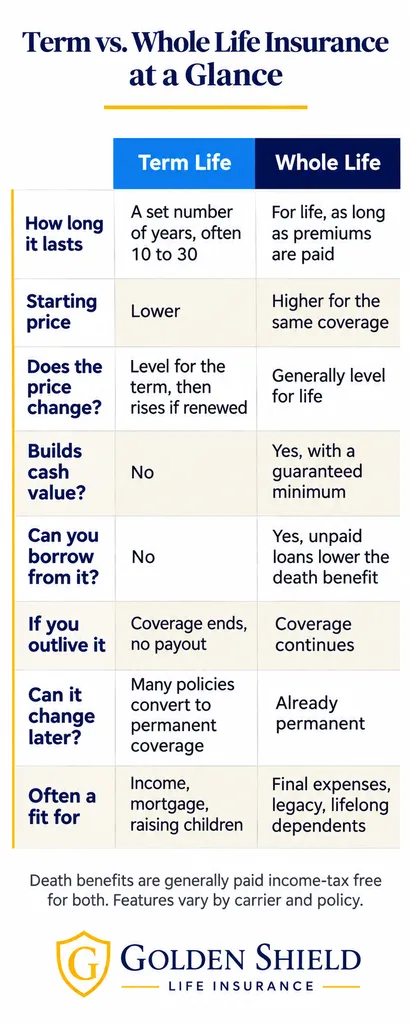
Term vs. whole life insurance at a glance: term lasts a set number of years, often 10 to 30, while whole life lasts for life as long as premiums are paid. Term has a lower starting price and no cash value. Whole life costs more, is generally level for life, and builds cash value with a guaranteed minimum you can borrow from. If you outlive term, coverage ends with no payout, but many policies convert to permanent coverage. Term often fits income, a mortgage, and raising children. Whole life often fits final expenses, legacy, and lifelong dependents.

Golden Shield Life Insurance compares both types of coverage across 130+ carriers rated A- or better by AM Best.6

What Is Whole Life Insurance?

Whole life insurance is a type of permanent life insurance. As long as you pay the premiums, the policy is designed to stay in force for your entire life and pay a death benefit to your beneficiaries whenever you pass away.

Traditional whole life comes with three guarantees written into the contract: a level premium, a death benefit, and a minimum cash value schedule. Some policies, called participating policies, may also pay dividends. Dividends are not guaranteed.4

Whole life is often used to cover final expenses, leave money to children or a church, pay estate costs, or support a dependent who will need help for life. Smaller whole life policies bought mainly for funeral and burial costs are usually sold as final expense insurance.

What Is Term Life Insurance?

Term life insurance pays a death benefit if you pass away during a set period, such as 10, 20, or 30 years. Level term policies keep the premium and the death benefit the same for the full term.

Because a term policy does not build cash value and many policyholders outlive the term, the premium is usually much lower than whole life for the same amount of coverage. That lower cost lets many families buy the large amount of coverage they need while children are young or a home loan is still being paid.

Mortgage protection insurance is often a term policy matched to the length and balance of a mortgage. Some term policies are also available without a medical exam for applicants who qualify.

Whole Life vs. Term: Pros and Cons

Term Life

Pros

  • Lowest starting premium for a large death benefit
  • Simple to understand and compare
  • Level premium for the term on level term policies
  • Often convertible to permanent coverage

Cons

  • Coverage ends when the term ends
  • Renewal premiums can rise sharply with age
  • No cash value
  • Health changes can make new coverage harder to buy later

Whole Life

Pros

  • Coverage for life as long as premiums are paid
  • Premium that generally never increases
  • Guaranteed cash value you may borrow against
  • Possible dividends on participating policies, not guaranteed

Cons

  • Much higher premium for the same death benefit
  • Cash value grows slowly in the early years
  • Surrendering early can mean getting back less than you paid
  • Unpaid loans reduce the death benefit

Whole Life vs. Term Life Insurance Cost by Age

Life insurance may cost less than you expect.

According to the 2025 Insurance Barometer Study from Life Happens and LIMRA, healthy adults age 35 and younger overestimated the cost of a term policy for themselves by about 7 to 12 times.7

That gap matters. Compare actual carrier premiums before deciding coverage is out of reach. The study measured beliefs about term pricing. It does not show that term is always the better product or that whole life is overpriced.

The table compares average monthly premiums for $500,000 of coverage: a 20-year level term policy versus a whole life policy, at ages 30, 40, 50, and 60. All figures assume a nonsmoker in good health and come from the same published study.

Average monthly premiums for $500,000 of coverage, nonsmokers in good health. Source: MoneyGeek analysis of 30+ insurers, updated November 2, 2026.8 Not a quote or offer of coverage.
Age20-Year TermWhole Life
WomenMenWomenMen
30$24$30$362$400
40$37$44$482$537
50$79$103$712$806
60$204$293$1,161$1,348

These are averages, not quotes. Your premium depends on your age, health class, tobacco use, state, and the carrier. Underwriting rules, product availability, and premium structures differ from one company to the next, and other published rate studies show different averages.

Why whole life costs more: A whole life insurer expects to pay the death benefit eventually, because the coverage never expires, and it must also fund the policy's guaranteed cash value. A 20-year term policy covers a shorter window, and many term policies end without a claim, so the insurer can charge far less for the same death benefit.

Compare Whole Life and Term Life Insurance Quotes

Compare coverage, premiums, and available living benefits with a licensed Golden Shield Life Insurance broker.

How Does Whole Life Cash Value Work?

Part of each whole life premium goes into the policy's cash value. The contract guarantees a minimum cash value schedule, and that value grows on a tax-deferred basis. Growth is slow in the first several years because early premiums also cover the cost of issuing the policy. Over time, you may be able to:

  • Borrow against it. A policy loan does not require a credit check, but interest accrues, and an unpaid loan reduces the death benefit.
  • Use dividends. If a participating policy pays dividends, they may buy more coverage, reduce premiums, or be taken as cash.
  • Surrender the policy. You receive the cash surrender value, coverage ends, and any gain over what you paid in may be taxable.

Cash value is a feature of permanent coverage, not a replacement for retirement savings. If you want more premium flexibility and growth tied to a market index, indexed universal life insurance is another permanent option, with its own costs and risks.

What Happens When Term Life Insurance Expires?

When a level term policy reaches the end of its term, you usually have three choices:

  • Let it end. No benefit is paid and premiums are not returned, unless you bought a return-of-premium policy.
  • Renew it. If the policy allows renewal, the new premium is based on your age at that time and often rises every year.
  • Convert it. Exchange some or all of the coverage for a permanent policy before the conversion deadline.

A year or two before the term ends, review whether you still need coverage. If the mortgage is paid and the children are grown, you may need less. If you still carry debts, have a spouse who depends on your income, or want final expenses covered, plan ahead while you still have options.

Can You Convert Term to Whole Life?

Often, yes. Many term policies include a conversion privilege that lets you exchange some or all of your term coverage for a permanent policy from the same insurer without a new medical exam or health questions. The new premium is based on your age when you convert, not your current health, which can be valuable if your health has changed. Deadlines, eligible products, and conversion amounts vary by carrier, so check your policy before the window closes.

Living Benefits: Whole vs. Term

Living benefits let you use part of a life insurance policy while you are still living. Many term and whole life policies offer accelerated death benefit riders. Some are included at no added premium, and others cost extra.

  • A living benefit rider may let you accelerate part of the death benefit after a qualifying illness.
  • Policies may include terminal illness, chronic illness, or critical illness provisions, and not every policy includes all three.
  • Eligibility rules, benefit limits, and fees vary by carrier and state.
  • Any amount you accelerate reduces the death benefit left for your beneficiaries.

Accessing whole life cash value is different. A policy loan does not require an illness, but it reduces the cash value and the death benefit if it is not repaid. Term policies have no cash value, so a living benefit rider is the only way to use them during life. Qualifying accelerated benefits for terminal illness are generally excluded from taxable income under federal rules.5

Learn more in our guide to the living benefits of life insurance. If your main concern is replacing a paycheck while you cannot work, income protection insurance is designed for that job.

Should You Buy Term and Invest the Difference?

"Buy term and invest the difference" means buying a lower-cost term policy and putting the money you would have spent on whole life into savings or investments. For disciplined savers, this can provide a large death benefit during the working years while building assets they control.

It works only if the difference is actually invested, consistently, for many years. Investments can lose value, and the strategy leaves you without life insurance once the term ends. Whole life costs more, but its guaranteed premium, death benefit, and cash value do not depend on market returns or saving habits.

Neither approach is right for everyone. A licensed financial professional can help you weigh insurance and investments together. Golden Shield Life Insurance focuses on the insurance side of that decision.

Can You Combine Whole and Term Life Insurance?

Yes, and many families do. A common approach is a larger term policy for needs with an end date and a smaller whole life policy for needs that never go away.

For example, a parent might own a 20-year term policy sized to replace income and pay off the mortgage, plus a smaller whole life policy for final expenses. When the term ends, the whole life coverage stays in place. Another approach, called laddering, uses two or more term policies with different lengths so coverage steps down as debts shrink.

Which Is Better for Your Financial Situation?

Start with the job the policy needs to do. These are common starting points, not rules.

  • Young family or new homeowner: Term often fits, because it buys the most coverage per dollar while children and a mortgage depend on your income.
  • Business owner with a loan or buy-sell agreement: Term often fits obligations with an end date, while permanent coverage may fit long-term succession plans. See life insurance for business owners.
  • Age 60 or older: Term may still cost less for a remaining debt, but term lengths narrow with age. Many people choose whole life or final expense coverage for lifelong needs. See life insurance for seniors.
  • Lifelong dependent or legacy goal: Whole life is often the better fit for a child with special needs, estate planning, or a gift to heirs or a charity.
  • Tight budget: Term usually provides the most protection per dollar. Buying more whole life than you can keep paying, then dropping it, can cost you.
Expert Advice

Most people I talk with do not need to pick a side. They need to match each policy to a specific job. Term is usually the most affordable way to protect a family while the mortgage, the kids, and the paycheck depend on you. Whole life makes more sense for needs that will still be there at 85, like final expenses or a child who will always need support.

As a former national medical underwriter, I look at health first, because your health today decides what each carrier will offer you. I never want anyone to buy whole life because it was pitched as an investment, or to skip it when a lifelong need is real.

Aaron Polk, Founder, Golden Shield Life Insurance

Whole Life vs. Term Life Insurance for Veterans

If you've served our country, thank you for your service. Whether you've served or not, the fundamental differences between whole life and term life insurance remain the same.

Some veterans already have Veterans' Group Life Insurance (VGLI), which is group term coverage with premiums that rise as you move into older age groups.1 Veterans with a service-connected disability rating may also qualify for VALife, a guaranteed acceptance whole life program with up to $40,000 of coverage and a two-year waiting period before the full benefit applies.2

Many veterans compare private term or whole life to add coverage on top of these programs. Eligibility, underwriting, and pricing depend on each person's age and health. Before you drop or replace any VA coverage, review what you would give up, including guaranteed acceptance and conversion rights.3 Our guide to life insurance for veterans covers VGLI, VALife, and private options in detail. Golden Shield Life Insurance is not affiliated with the U.S. Department of Veterans Affairs.

Thank You for Serving Our Country

Thank you for your service to our country. Now, allow our family to protect your family. Your shield is ready. Are you?

How to Compare Whole Life and Term Life Quotes

To compare quotes fairly, use the same death benefit and look at the whole policy, not just the first premium.

  1. Decide what the coverage needs to pay for and for how long.
  2. Compare the same death benefit across several carriers rated A- or better by AM Best.
  3. Ask which riders are included, including living benefits and conversion options.
  4. Ask whether you may qualify for life insurance without a medical exam and how that affects the price.
  5. On any whole life illustration, check the guaranteed values, not only the projected ones.

Ready to see prices? Start with term life insurance quotes or whole life insurance quotes. An independent broker can also shop both side by side for you. Call (678) 884-4653 or request free quotes.

Pick your shield, Golden Shield Life Insurance

Talk With a Licensed Agent or Book a Free Consultation.

Pick your shield today.

Have a question? Call us at (678) 884-4653.

Book Your Consultation
Common Questions

Whole Life vs. Term Life Insurance FAQs

Is whole life insurance better than term life insurance?

Neither is better for everyone. Term life is often the better value for needs with an end date, such as a mortgage or raising children. Whole life is often the better fit for needs that last a lifetime, such as final expenses or a lifelong dependent.

Why does whole life insurance cost more than term?

Whole life is designed to pay a death benefit whenever you die and to build guaranteed cash value. Term covers a limited period, and many policies end without a claim. Funding lifelong coverage and cash value requires a higher premium for the same death benefit.

How much does $500,000 of whole vs. term life cost?

In one 2026 study of 30+ insurers, a healthy 40-year-old nonsmoker paid an average of about $37 to $44 a month for $500,000 of 20-year term, versus about $482 to $537 a month for whole life. Your quote will differ.

Can I have both term and whole life insurance?

Yes. Many people own a larger term policy for their working years and a smaller whole life policy for final expenses or legacy goals. This combination can provide more total coverage while keeping premiums manageable.

Can I switch from term to whole life without a medical exam?

Often, yes. Many term policies include a conversion privilege that lets you switch to a permanent policy from the same insurer without new medical questions, as long as you convert before the deadline. Your new premium is based on your age at conversion.

Is whole life or term life better after age 60?

It depends on the need. Term can still cost less at 60 for a remaining debt or a spouse's income, but term lengths narrow with age. For final expenses or legacy goals, many people over 60 choose whole life or final expense coverage.

Does term or whole life insurance offer living benefits?

Both can. Many term and whole life policies offer accelerated death benefit riders for qualifying terminal, chronic, or critical illness. Terms vary by carrier, and any amount you accelerate reduces the death benefit. Only whole life also has cash value you may borrow against.

Do veterans need additional private coverage if they already have VGLI?

Not always, but many choose it. VGLI premiums rise with age, and the coverage amount may not match your family's needs. Comparing private term or whole life can show whether added coverage fills a gap. Review any change before replacing VA coverage.

Your shield is ready. Are you?

Something went wrong sending your request. Please try again, or call or text us at (678) 884-4653.

What Our
Clients Say

Atlanta SkyView Ferris wheel Georgia State Capitol gold dome in Atlanta
★★★★★
"

Disclaimers

Aaron Polk, founder and licensed agent at Golden Shield Life Insurance

Aaron Polk

Founder, Golden Shield Life Insurance · Former National Medical Underwriter and Licensed Life Insurance Broker · NPN 21216745 · Georgia Agency License 242517

Aaron founded Golden Shield Life Insurance after a 2007 accident showed him how fast a steady life can change. He compares more than 130 carriers to help families, veterans, and business owners find honest coverage, with a focus on people other agents pass over.

Last reviewed: November 2026. This page is reviewed and updated as published rates, carrier practices, VA programs, and tax rules change.

Disclaimers View

Facts on This Page Are Supported By

  • 1U.S. Department of Veterans Affairs. Veterans' Group Life Insurance (VGLI). Supports that VGLI is group term coverage with premiums based on age groups. va.gov VGLI
  • 2U.S. Department of Veterans Affairs. Veterans Affairs Life Insurance (VALife). Supports VALife's guaranteed acceptance whole life coverage up to $40,000 for veterans with a service-connected disability rating and its two-year waiting period. va.gov VALife
  • 3U.S. Department of Veterans Affairs. VGLI conversion to an individual policy. Supports that VGLI coverage can be converted to an individual whole life policy with a participating insurer. va.gov VGLI
  • 4National Association of Insurance Commissioners. Life Insurance Buyer's Guide. Supports the general descriptions of term life, whole life, cash value, dividends, and premium differences on this page. NAIC Life Insurance Buyer's Guide (PDF)
  • 5Internal Revenue Service. Publication 525, Taxable and Nontaxable Income. Supports the tax treatment of accelerated death benefits described in the living benefits section. irs.gov/publications/p525
  • 6AM Best. Insurer financial strength ratings. Supports the A- or better carrier rating standard referenced on this page. ambest.com
  • 7Life Happens and LIMRA. 2025 Insurance Barometer Study, published June 2025. Supports that healthy adults age 35 and younger overestimated the cost of a term policy by about 7 to 12 times. lifehappens.org
  • 8MoneyGeek. How Much Is a $500,000 Life Insurance Policy?, updated November 2, 2026. Supports the average monthly premiums for $500,000 of 20-year term and whole life coverage for nonsmokers in good health, based on quotes from 30+ insurers. moneygeek.com

Disclaimers

  • Golden Shield Life Insurance is not affiliated with, endorsed by, or acting on behalf of the U.S. Department of Veterans Affairs or any government agency.
  • This page is educational and is not financial, legal, or tax advice.
  • Coverage, pricing, riders, and product availability vary by carrier, state, age, health, and policy terms.
  • Golden Shield Life Insurance does not guarantee approval, pricing, or benefit eligibility.
  • VGLI and VALife rates, eligibility rules, and terms are set by the U.S. Department of Veterans Affairs and are subject to change.
  • Sample premiums shown are published averages from a third-party rate study for nonsmokers in good health. They are not quotes or offers of coverage. Actual premiums and eligibility are set by each insurer. Whole life dividends are not guaranteed, and cash value, loan, rider, and conversion terms are set by each policy.
  • Policy loans and withdrawals on private permanent policies may reduce the death benefit and may have tax consequences.
  • Tax treatment may change and depends on your situation. Consult a qualified tax professional.