Life Insurance for Seniors

Compare affordable term life, whole life, and final expense insurance for seniors from age 50 through 89.

  • Shop 100% Online or With an Agent
  • Fast & Easy Application
  • Quotes Are Always Free
Senior couple sitting together on the beach on a sunny day

No Medical Exam Required

Aaron Polk, founder of Golden Shield Life Insurance

By Aaron Polk, Licensed Agent and Former National Medical UnderwriterGolden Shield Life Insurance · Read Our Reviews · About Aaron Polk
NPN 21216745 · Updated November 2026 · 28 min read

What Is Senior Life Insurance?

Senior life insurance is coverage for adults generally age 50 and older. While younger people often buy life insurance to replace income, seniors may focus on funeral expenses, paying off debts, protecting a spouse, or leaving an inheritance.

Coverage typically costs more with age, but many term life, whole life, and final expense policies are available without a medical exam.

Whole life insurance provides lifelong coverage, fixed premiums, and cash value.6 Term life insurance covers a set number of years. Some policies also include living benefits you can access if you experience a qualifying serious illness.6

It's about making sure your family isn't left with your final expenses and remembering you as someone who planned ahead.

Here's what we'll cover:

  • The types of life insurance seniors can purchase.
  • How your age and health affect coverage and monthly premiums.
  • How cash value and living benefits can help you while you're alive, and what your beneficiaries receive when you're gone.
Aaron Polk on a sunny patio getting a kiss from Max, his Golden Doodle

Meet Max

Max, Our Golden Doodle and Operations Manager

Editor's Note

Most people who call me about senior coverage think they waited too long, or that a health condition already ruled them out. Neither one is usually the whole story.

The question that matters most is whether the policy pays the full benefit from day one or only after a waiting period.

Aaron PolkFounder and Licensed Agent, Golden Shield Life Insurance

Types of Life Insurance for Seniors

Term Life Insurance for Seniors

Term life insurance provides coverage for a set number of years, typically 10, 15, or 20 years. If you pass away while the policy is active, your beneficiaries receive the death benefit, generally income tax-free.19 Once the term expires, coverage ends unless you renew or convert it, if your policy allows.14

Term life insurance is generally more affordable than whole life insurance for the same coverage amount. Seniors in their 50s and 60s may still qualify for substantial coverage, while those in their 70s typically have fewer options and shorter terms.

Many term policies are available without a medical exam. Some also include living benefits that let you access part of your coverage if you're diagnosed with a qualifying serious illness.

Whole Life Insurance for Seniors

Whole life insurance provides lifelong coverage with fixed monthly premiums and a guaranteed death benefit, as long as you keep your policy active. Unlike term life insurance, your coverage doesn't expire after 10 or 20 years.

Seniors often purchase whole life insurance to pay funeral expenses, cover outstanding debts, protect a surviving spouse, or leave an inheritance to children and grandchildren. You can name one or multiple beneficiaries, and the death benefit is generally paid income tax-free.19

Whole life policies also build cash value over time. You can borrow against that money to help with medical bills, home expenses, retirement needs, or unexpected costs. Unpaid loans will reduce the amount your beneficiaries receive.6

Many whole life policies for seniors are available without a medical exam, including options for people with health conditions. Premiums are generally higher than term life insurance, but your monthly payment stays the same.

Get a State Licensed Agent Near You

Meet with us online, by video, or over the phone. Call or chat below, or schedule a call back around your schedule. Rather do it on your own time? Apply 100% online anytime. You can verify any agent's license with your state insurance department.8

Final Expense and Burial Insurance for Seniors

Final expense insurance, also called burial insurance, is a smaller whole life policy designed to help pay for funeral services, burial, cremation, and other expenses left behind.

According to the National Funeral Directors Association, the national median cost of a funeral with burial was $8,300, compared with $6,280 for a funeral with cremation in 2023.4 Cemetery plots, headstones, and other services can add thousands more.10

Seniors commonly purchase $5,000 to $25,000 in coverage to help their families avoid paying these expenses out of pocket. The money goes directly to your beneficiaries, who can also use it for medical bills, outstanding debts, or other needs.

Most final expense policies are available without a medical exam, and some offer coverage through age 85.12 Premiums remain fixed, and coverage lasts your entire life as long as payments are maintained. Depending on your health and policy, the full death benefit may be available immediately or after a waiting period.

Simplified Issue and Guaranteed Acceptance Life Insurance for Seniors

Simplified issue and guaranteed acceptance life insurance are two options for seniors who want coverage without a medical exam. Both offer permanent coverage, but the application requirements are different.

Simplified issue life insurance requires a few health questions but no medical exam.7 Many applicants receive an approval decision within minutes, and qualifying policies provide the full death benefit from the first day.

Guaranteed acceptance life insurance requires no medical exam or health questions. Eligible seniors cannot be declined because of their medical history, even if they've been turned down for coverage before.

Most guaranteed acceptance plans have a two-year waiting period for death from natural causes. If death occurs during that time, beneficiaries generally receive all premiums paid, sometimes plus 10% interest, depending on the insurer.15

Both options help seniors plan for funeral expenses, pay remaining debts, or leave an inheritance to their families.

Best Life Insurance Companies for Seniors

The best life insurance company for seniors is the one that gives you the lowest cost, the highest benefit for your face amount, and the least friction getting approved. Measured that way, we recommend five: Fidelity Life, Americo, Mutual of Omaha, Ethos, and Corebridge Financial for guaranteed issue. Each offers no medical exam options, fast online applications, and quick decisions, often in minutes, and each issuing company is rated A- or better by AM Best.9 Which one comes out on top for you depends on your age, health, and the amount you need, so we compare them side by side before you apply. Every plan also comes with a free-look period, often 30 days, to cancel for a full refund.6

Fidelity Life

Senior term and whole life, often with no medical exam.

  • Senior term for ages 50 to 70, up to $150,000
  • Senior whole life for ages 50 to 85
  • Final expense up to $35,000, through age 85
  • Guaranteed issue up to $25,000, through age 85
  • Pay your premium by credit card

Americo

Term, whole life, and mortgage protection with living benefits.

  • Final expense with a full benefit from day one, for those who qualify for the level plan
  • A guaranteed issue option for health concerns
  • Living benefits on eligible plans
  • Child and grandchild riders on eligible plans

Mutual of Omaha

Final expense and term coverage from a long-standing name.

  • Living Promise whole life, ages 45 to 85
  • Up to $50,000 with no medical exam
  • A graded plan for some health conditions
  • Terminal illness and nursing home benefit on eligible plans

Ethos

Apply online on your own, with fast decisions and no medical exam.

  • Online term life for eligible applicants, ages 20 to 8518
  • Guaranteed issue whole life for ages 65 to 8518
  • No medical exam required
  • Living benefit riders on select policies
  • Policies are issued by partner insurance companies, not by Ethos
30-day money back guarantee seal

30-Day Money Back Option

Every plan above comes with a free-look period, often 30 days. If you change your mind, cancel within that window for a full refund of the premiums you paid.

Also in Our Senior Lineup

Baltimore Life

iProvide Whole Life for ages 45 to 89, from $2,500 to $50,000. A short health application with an immediate decision, and no exam or underwriter phone call. Pay for life, for 20 years, or in one payment. A $1,000 cash draft can reach your beneficiary quickly to cover needs until the claim is settled.13 Silver Guard is a second simplified issue whole life option, with a terminal illness benefit at no extra cost.16

Banner Life

OPTerm term life from $100,000, a Legal & General America company. Ten and 15-year terms issue through age 75, and 20-year terms through 70 for non-tobacco applicants. An accelerated death benefit rider is included with every policy.14

Guaranteed Issue

Why We Use Corebridge Financial

For guaranteed issue coverage, we place clients with Corebridge Financial. We have seen them pay claims, their rates are competitive, and acceptance is immediate for anyone in the age range.

  • Ages 50 to 80, no health questions, no exam
  • $5,000 to $25,000 of coverage
  • First two years: 110% of premiums paid for a natural death
  • Full benefit from year three on
Estimate Your Guaranteed Issue Premium

Guaranteed Issue Whole Life is issued by American General Life Insurance Company, a Corebridge Financial company. Not available in New York. Terms per Corebridge, checked November 2026.

Our Insurance Company Reviews

Honest reviews we wrote so you know what to expect before you apply.

Senior Life Insurance Rates and Costs

How much does life insurance cost for seniors? Your rate depends on your age, health, the amount of coverage you want, and the type of policy you choose. Two people the same age can pay very different premiums, even when they apply for the same amount of coverage.

Before you compare senior life insurance rates, think about what you want the money to do. Are you covering funeral expenses, paying off a mortgage, protecting your spouse, or leaving an inheritance? Someone looking for $15,000 in burial insurance will pay far less than someone who wants $250,000 to leave to family.

What Affects the Cost of Life Insurance for Seniors

  • Age: Life insurance generally costs more as you get older, because insurers price coverage based on life expectancy. Applying at 60 instead of 70 can make a noticeable difference, and prices tend to rise fastest between 75 and 80.1
  • Gender: Women usually pay less than men of the same age because they tend to live longer. At 65, the average for $10,000 of final expense coverage is about $50 a month for women and $66 for men.1
  • Health: Your medical history, medications, and overall health can affect your price. Some insurance companies are more flexible with certain conditions than others, which is why comparing carriers matters.
  • Tobacco use: Smokers and tobacco users usually pay noticeably more for the same coverage.
  • Coverage amount: A $100,000 policy generally costs more than a $25,000 policy. Choose an amount that matches what you want your beneficiaries to receive and what you can comfortably afford each month.
  • Policy type and length: Term life insurance generally costs less than whole life insurance for the same death benefit. Whole life costs more because it builds cash value and can last your entire life, as long as premiums are paid.
  • Medical exam and health questions: Many senior life insurance plans require no medical exam. Policies that ask a few health questions often cost less than guaranteed acceptance plans and pay the full benefit from day one.

Ways to Save Money on Life Insurance

  • Pay annually instead of monthly. Some insurance companies charge less when you pay for the entire year at once.
  • Ask about discounts and policy options. Some companies offer discounts for bundling policies or other ways to reduce your premiums.
  • Compare quotes from multiple companies. Every insurance company sets its own rates. Shopping around can help you find the same coverage for less money.
  • Ask about state discounts and credits. Life insurance rates can vary by state and insurance company. Ask your broker if any state-specific savings or programs are available.
  • Consider term life insurance. Term life insurance provides coverage for a set period, such as 10, 15, or 20 years, and usually costs less than whole life insurance.
  • Choose coverage you can comfortably afford. Pick an amount of life insurance that fits your budget without putting a strain on your finances, so you can feel confident, secure, and proud of the protection you have in place.

The rate tables below show average monthly costs by age and policy type. Your actual quote will depend on the insurance company, your health, and your application.

$50–66a month at age 65
$64–84a month at age 70
$87–113a month at age 75
$10,000 final expense, average monthly premium
AgeWomenMen
55$36$46
60$42$53
65$50$66
70$64$84
75$87$113
80$125$164
85$155$203

By Policy Type

Average monthly premium (women / men)
Policy TypeAge 55Age 65Age 75
Term life
$100,000, 10-year
$32 / $41$73 / $101$161 / $231
No-exam term
$100,000, 10-year
$36 / $46$100 / $140$238 / $298
Final expense
$15,000
$53 / $66$74 / $96$130 / $160
Guaranteed issue
$15,000
$65 / $80$90 / $116$156 / $195

Happy Clients, Real Stories

Both were turned down somewhere else before they called us.

Mike's Story

“Even after my heart surgery, Aaron found me protection with no exam. Now my wife is financially secure and I have total peace of mind.”

The relief: turned down elsewhere after heart surgery, Mike got coverage with no exam, and his wife is protected.

Watch the videoRead the review on Google

Glen's Story

“Aaron is more than an agent, he's a persistent caring person who never gives up until he finds the policy which best fits you and your family needs.”

The relief: turned down elsewhere, Glen, a police officer, got final expense coverage with no waiting period and living benefits.

Watch the videoRead the review on Google

Your story can start the same way. Call or text (678) 884-4653.

Life Insurance for Seniors by Age

Life insurance for seniors generally costs more as you age, but affordable coverage is still available. Your monthly premium depends on your age, health, coverage amount, and whether you choose term life, whole life, or final expense insurance.

Here's how coverage options and costs change at different ages.

Life Insurance for Seniors Over 65

At 65, you may still qualify for term life insurance lasting 10, 15, or 20 years,14 along with permanent whole life and final expense coverage. Term life generally offers more coverage for a lower monthly premium, while whole life provides lifelong protection with fixed payments.

We recently helped a healthy, nonsmoking 65-year-old woman obtain a $100,000, 20-year term policy with living benefits for approximately $200 per month. Read her Google review.

Life Insurance for Seniors Over 75

At 75, term life options become more limited, but whole life and final expense insurance remain available. Many policies require no medical exam, and some provide the full death benefit from the first day.

Your monthly premium depends on your health, coverage amount, and the insurance company. Comparing companies can make a difference, especially if you take medications or have existing health conditions.

Life Insurance for Seniors Over 80

At 80, many seniors choose whole life or final expense insurance to cover funeral expenses, remaining debts, or leave money to family. These policies often provide fixed premiums without requiring a medical exam.

Seniors with savings may also consider fixed annuities. A deposit earns interest at a guaranteed rate for a specified period, potentially more than a traditional savings account.20 Beneficiaries can receive the remaining contract value after death.

Life Insurance for Seniors Over 85

Life insurance is still available after 85, although fewer companies accept new applications. Some plans accept applications through age 89.13

For seniors with existing savings, fixed annuities may provide another option. They can offer tax-deferred growth, guaranteed interest, and beneficiary designations without requiring monthly life insurance premiums.20

Annuities aren't life insurance, and withdrawal restrictions and tax rules differ. Annuities are not FDIC insured and may have surrender charges for early withdrawals. Both can help seniors plan for final expenses or leave money to family.

Thinking About Term After 60?

Who

Seniors in their 60s or early 70s who still have a mortgage, a spouse who depends on their income, or debts with an end date.

What

Term life with a level premium for 10, 15, or 20 years. After that, many plans renew each year at a higher price.

When

Sooner is better. Banner Life OPTerm, for example, issues 10 and 15-year terms through age 75 and 20-year terms through age 70 for non-tobacco users.

Where

Through an independent broker who can compare companies like Banner Life and Mutual of Omaha, or online through Ethos.

Why

Term usually costs the least per dollar for a need that ends. Many term policies can be converted to permanent coverage. Banner Life OPTerm, for example, converts until age 70, or during the first five policy years if issued at 66 or older.14

A free tree planted in your name by Golden Shield Life Insurance
A free tree planted in your name.

Life Insurance for Seniors With Health Conditions

Many seniors worry they won't qualify for life insurance because of their health. You may have diabetes, high blood pressure, heart disease, or a history of cancer and assume an insurance company will turn you down. That's not always the case.

As a former national medical underwriter, I've seen how differently insurance companies evaluate the same medical conditions. One company may decline an application while another offers coverage at an affordable monthly premium.

Common Health Conditions That Concern Seniors

  • Diabetes: Many seniors with Type 2 diabetes can qualify for coverage, especially when their condition is well managed.
  • High blood pressure or cholesterol: Taking medication doesn't automatically prevent you from getting life insurance.
  • Heart disease, heart attacks, or strokes: Coverage may still be available depending on your treatment, recovery, and medical history.
  • Cancer: Your diagnosis, treatment, and how long you've been cancer-free can affect which policies are available.
  • COPD and breathing conditions: Some insurers offer coverage depending on the severity of your condition and whether you require oxygen.
  • Kidney disease: Your kidney function, treatment history, and overall health help determine eligibility.
  • Mobility limitations or disabilities: Using a wheelchair, walker, or other mobility equipment doesn't automatically mean you cannot obtain coverage.

Can Seniors Get Life Insurance Without a Medical Exam?

Yes. Many seniors qualify for no medical exam life insurance, including simplified issue whole life and final expense policies. These may require health questions and a review of your medical history, but no physical examination.7

For seniors with more serious medical conditions, guaranteed acceptance life insurance is another option. Eligible applicants cannot be declined because of their health, although most policies include a two-year waiting period for death from natural causes.15

My advice: Don't assume your health makes you uninsurable. Before accepting a decline or purchasing guaranteed acceptance coverage, find out whether another company can approve you for a policy with full benefits from the first day.

No Medical Exam Life Insurance for Seniors

Many seniors can qualify for term life, whole life, or final expense insurance without a medical exam, blood work, or doctor visits. Some policies offer approval within minutes and coverage starting the same day.

Types of No Medical Exam Life Insurance

Simplified Issue Life Insurance

Requires a few health questions and may include a review of your prescriptions and medical history.7 Approved policies can provide the full death benefit from the first day.

Guaranteed Acceptance Life Insurance

Requires no medical exam or health questions. Eligible seniors cannot be declined because of their health. Most policies have a two-year waiting period for death from natural causes, during which beneficiaries generally receive premiums paid, sometimes plus interest.12

Before choosing guaranteed acceptance coverage, check whether you qualify for a policy with full benefits from the first day.

What Are Waiting Periods for Seniors?

Waiting periods are commonly associated with guaranteed acceptance life insurance and are known as graded death benefits. These policies are designed to provide coverage to seniors regardless of their medical conditions, without health questions or a medical exam.

Most guaranteed acceptance policies have a two-year waiting period, while some have three years. During this time, you're making monthly premium payments toward a policy that will provide a guaranteed death benefit to your beneficiaries once the waiting period ends.

If you pass away from natural causes during the waiting period, your beneficiaries generally receive the premiums you've paid, plus any interest specified in the policy. Accidental death may be covered immediately.1215

It's a way to start planning today for funeral, burial, or cremation expenses without worrying about being declined because of your health. Once the waiting period ends, the full death benefit becomes available as long as your policy remains active.

See what guaranteed coverage could cost with our free guaranteed issue life insurance calculator.

Free will from Golden Shield Life Insurance
Golden Shield Life Insurance shield pillow

Life Happens Fast.
Your Shield Is Ready, Are You?

Prefer to talk now? Call or text (678) 884-4653

Rather do it yourself?

Apply 100% online, anytime, with no phone call needed.

Apply Online Now

Want a decision online? You can also apply through our partner Ethos. You will complete your application on their secure site.

Living Benefits for Seniors: Term and Whole Life Insurance

Living benefits allow you to use certain benefits from your life insurance policy while you're still alive. Depending on your coverage, these benefits may help with a serious illness, medical expenses, or other financial needs.

Living Benefits for Health Conditions

Many term and whole life insurance policies offer accelerated death benefits. If you're diagnosed with a qualifying illness, you may be able to access part of your death benefit while you're living.121314

Common qualifying conditions include:

  • Terminal illness: A diagnosis that meets the policy's life expectancy requirements.
  • Chronic illness: A condition that prevents you from performing certain everyday activities or requires substantial supervision.
  • Critical illness: A qualifying event such as a heart attack, stroke, or certain cancers.

The money can help pay medical bills, home care, living expenses, or other needs. Any amount you receive generally reduces the death benefit left to your beneficiaries. Not every policy includes all three benefits.6

Whole Life Insurance: Financial Living Benefits

Whole life insurance offers another benefit that is separate from illness coverage: cash value.

As you pay your premiums, your policy builds cash value over time. You may be able to borrow against it or make withdrawals to help pay for home repairs, car expenses, medical bills, retirement needs, or everyday living expenses.

Unlike accelerated death benefits, you don't need to become sick to access your available cash value.

Policy loans accrue interest, and unpaid loans or withdrawals can reduce the money your beneficiaries receive. Cash value also takes time to build.6

For seniors, these are two different ways life insurance may help: health-related benefits when a qualifying illness occurs, and financial benefits through the cash value of a whole life policy.

Learn more about living benefits of life insurance.

Aaron Polk explains life insurance for seniors

Watch: Aaron Polk explains life insurance for seniors.

Read the transcript

0:00What senior life insurance is

Senior life insurance is not one product. It is a market label for several policies sold to applicants who are generally fifty and older. Insurance companies set their own issue-age windows, and some products accept applications through age eighty-five.

0:35What it costs by age

Age moves the price more than anything else. For a ten thousand dollar final expense policy, monthly averages published by MoneyGeek in June 2026 for non-tobacco applicants run about thirty-six dollars for women and forty-six for men at age fifty-five. At sixty-five, about fifty and sixty-six. At seventy-five, about eighty-seven and one hundred thirteen. At eighty-five, about one hundred fifty-five and two hundred three. These figures are illustrative only and not an offer of coverage.

1:30The sharpest jump

The sharpest price increase generally falls between ages seventy-five and eighty, where averages rise about forty-four percent for women and forty-five percent for men.

1:50Four types of coverage

Term life covers a set period, builds no cash value, and is generally available to about age seventy-five. Whole life is permanent coverage that builds cash value, with issue ages commonly running to eighty-five. Final expense is a smaller permanent policy for funeral costs and similar bills, and generally requires no medical exam. Guaranteed issue asks no health questions at all and accepts applicants within a stated age band, usually about fifty to eighty-five.

2:45No medical exam does not mean no underwriting

No medical exam does not always mean there is no underwriting. Simplified issue policies may still review health questions and prescription records. Only guaranteed issue skips health questions entirely.

3:15Waiting periods and graded benefits

Waiting periods and graded benefits are common when health questions are not asked. In year one and year two of a graded policy, a natural death may return the premiums paid plus an added amount, often around ten percent, rather than the full face amount. From year three onward the full benefit generally becomes payable. Accidental death is often payable in full from day one, even during the waiting period.

4:00The question to ask out loud

The most important question to ask before signing is this. If death occurs during the first two years, exactly how much will the beneficiary receive?

4:20What a low advertised price really buys

Widely advertised low prices may only buy units of coverage. A price of nine dollars and ninety-five cents may purchase one unit, and reaching a ten thousand dollar benefit can require eight or more units depending on age and state.

4:50Health conditions

Conditions like controlled high blood pressure or type two diabetes are often manageable with health questions. Others, such as current cancer treatment or dialysis, may need more careful placement with specific insurance companies.

5:15How much coverage

To size coverage, add what would be owed, including the national median of eight thousand three hundred dollars for a funeral with viewing and burial, then subtract available savings and coverage already in force.

5:45About Golden Shield Life Insurance

Golden Shield Life Insurance is an independent broker comparing more than one hundred thirty insurance companies rated A minus or better by AM Best. Aaron Polk, licensed agent, NPN 21216745. Call or text 678-884-4653. This is educational information, not financial, legal, or tax advice.

Who

Who Senior Life Insurance Is For

Your age, your health, and the people you want to protect decide which plans fit.

What a Former Medical Underwriter Wants Seniors to Know

Before becoming an independent broker, I worked as a national medical underwriter, reviewing life insurance applications and medical records. That experience taught me what seniors should understand before choosing a policy.

Why Insurance Companies Make Different Decisions

Every insurer has its own underwriting guidelines. A senior with controlled type 2 diabetes may qualify for immediate coverage with one company but receive a graded benefit offer from another. Underwriters consider medical history, medications, treatment, and overall health, not just a diagnosis.

No Medical Exam Doesn't Mean No Underwriting

Simplified issue life insurance eliminates the medical exam but may still require health questions and prescription record checks.7 Some policies provide full coverage immediately, while others have modified benefits during the first two years.13

Term vs. Permanent Life Insurance Near Retirement

Term life insurance may be more affordable for temporary needs, such as a mortgage or income replacement. Permanent life insurance provides lifelong coverage when premiums are maintained, making it an option for funeral expenses or leaving money to family. Some seniors combine term coverage with a smaller final expense policy.

Choose Coverage You Can Afford to Keep

Life insurance only protects your family while the policy remains in force. Missing payments can cause coverage to lapse, although some whole life policies offer options using accumulated cash value.6

I would rather see a client keep a $15,000 policy for life than lose a $40,000 policy after four years.

What I Review Before Recommending Coverage

  • Medical history, medications, and recent treatments.
  • Which insurers may offer immediate full benefits.
  • Waiting periods and beneficiary payouts.
  • Coverage needs and long-term affordability.

Aaron Polk | Former National Medical Underwriter and Licensed Independent Life Insurance Broker, Golden Shield Life Insurance.
Coverage and underwriting decisions vary by insurer, policy, and state.

Buying Life Insurance for Your Parents: How It Works and What to Know

You can purchase life insurance for your mother, father, or both parents to help pay for funeral expenses, outstanding debts, or other costs after they pass away. You can also pay the monthly premiums yourself so your parents don't have another bill to worry about.

However, your parent must know about the policy and give their consent. You generally must also have an insurable interest, meaning their death could create a financial loss or responsibility for you.6

How to Buy Life Insurance for a Parent

  1. Talk with your parent. Explain why you want coverage and get their permission. They will need to participate in the application and provide their signature.
  2. Choose the coverage amount. Consider funeral, burial, or cremation costs, remaining debts, and any money you'd like available for family expenses.
  3. Compare policy options. Term life may work for younger parents with temporary needs. Whole life and final expense insurance provide lifelong coverage, while guaranteed acceptance plans help parents with serious health conditions.
  4. Complete the application. Your parent may need to answer health questions, although many senior life insurance policies don't require a medical exam.
  5. Decide who owns and pays for the policy. You may be able to become the policy owner, pay the premiums, and name yourself as a beneficiary, with your parent's consent and the insurer's approval.

Can I Buy Life Insurance for My Parents Without Their Permission?

No. You cannot secretly purchase life insurance on a parent. They must consent to the coverage and complete the insurer's required authorization.

My advice: If you're concerned about eventually paying for your parents' funeral expenses, have the conversation while they're here to help make the decisions. You can take responsibility for the monthly payments while they help choose how they want their final arrangements handled.

Download Baltimore Life's free Memorial Planning Guide (PDF) to record your parent's wishes together.17 Looking for a parent's lost policy? Try the free NAIC Life Insurance Policy Locator.11

Your Shield Is Ready. Are You?

We listen and explain the fine print.

Two people holding hands across a table while discussing life insurance with Golden Shield Life Insurance

What

What Coverage You Can Get

The plans, the prices, and the insurance companies we trust most for seniors.

Which Life Insurance Policy Fits You?

The best life insurance for seniors depends on your age, health, budget, and what you want the policy to accomplish. Compare these six options to find the coverage that fits your needs.

Whole Life Insurance

Permanent life insurance that provides lifelong protection, fixed premiums, and cash value that grows over time.

  • Coverage: Lifetime
  • Medical Exam: Sometimes required
  • Best For: Lifelong protection, inheritance, and family security
  • Cash Value: Yes
Explore Whole Life Insurance

Final Expense Insurance

Affordable permanent life insurance designed to help your family pay funeral expenses, burial costs, and final bills.

  • Coverage: Lifetime
  • Medical Exam: Usually not required
  • Best For: Funeral expenses and remaining bills
  • Cash Value: Typically included
Explore Final Expense Insurance

Guaranteed Issue Life Insurance

Whole life insurance with guaranteed acceptance for eligible ages, regardless of medical history, with no health questions or medical exam.

  • Coverage: Lifetime
  • Medical Exam: None
  • Best For: Seniors with serious health conditions
  • Cash Value: Typically included
  • Death Benefit: Usually graded during the early policy years
Explore Guaranteed Issue Insurance

No Medical Exam Life Insurance

Get term or permanent life insurance without blood tests or a medical examination, often with a faster application and approval process.

  • Coverage: Term or lifetime
  • Medical Exam: None
  • Best For: Seniors who prefer a simpler application
  • Cash Value: Available with qualifying permanent policies
Explore No Medical Exam Insurance

Term Life Insurance

Affordable coverage for a set number of years, ideal for protecting income, paying off a mortgage, or covering temporary financial obligations.

  • Coverage: Commonly 10, 15, or 20 years for eligible seniors
  • Medical Exam: May be required
  • Best For: Mortgage protection and income replacement
  • Cash Value: None
Explore Term Life Insurance

No Medical Exam Term Life Insurance

Term life insurance without a medical examination, offering larger death benefits for qualified applicants through a streamlined application.

  • Coverage: Commonly 10 to 20 years for eligible seniors
  • Medical Exam: None
  • Best For: Larger coverage amounts without medical testing
  • Cash Value: None
Explore No Medical Exam Term

What About Accidental Death Insurance?

Accidental death and dismemberment insurance provides additional financial protection for covered accidents. Unlike traditional life insurance, it does not pay a death benefit for illness or natural causes.

Looking for permanent coverage? Compare Whole Life Insurance Quotes.

When & Why

When to Buy and What Lasts

Timing, reasons, and coverage that lasts your lifetime.

When to Buy, and Why

Sooner usually costs less. Your price is set by your age on the day you apply, and averages rise fastest between 75 and 80.1

When to Buy

  • Before your next birthday
  • While your health is steady
  • Before work coverage ends at retirement
  • Before a term policy ends, while you can still convert it

Why Seniors Buy

  • A funeral: $8,300 median with burial4
  • Final medical bills and debts
  • Income for a spouse when one Social Security check stops5
  • A pension with no survivor benefit
  • Raising grandchildren, or leaving them a gift

Permanent Life Insurance for Seniors

Seniors often choose permanent life insurance because of its cash value growth, lifelong coverage, and the ability to access money while they're still living. Unlike term life insurance, permanent policies are designed to remain active throughout your lifetime, as long as the policy's requirements are met.

The cash value can grow tax-deferred6 and may be used for medical expenses, home improvements, retirement needs, or unexpected bills. You don't have to become sick to access this money. Depending on your policy, you can borrow against the cash value or make withdrawals.

Types of Permanent Life Insurance

  • Whole Life Insurance: Provides fixed premiums, guaranteed cash value growth, and a guaranteed death benefit while the policy remains in force.
  • Universal Life Insurance: Offers flexible premium payments and adjustable death benefits. Cash value earns interest, but the policy must have enough money to cover its ongoing costs.
  • Indexed Universal Life Insurance (IUL): Credits interest based partly on a market index, such as the S&P 500, subject to caps, floors, and other policy limits.
  • Guaranteed Universal Life Insurance: Focuses on providing a guaranteed death benefit to a specified age, often 100 or beyond, with limited cash value growth.

What Happens to Cash Value When You Die?

One thing seniors should understand is that cash value and the death benefit are not usually added together.

For example, if you have a $100,000 whole life policy with $20,000 in cash value, your beneficiaries generally receive the $100,000 death benefit, not $120,000. Some universal life policies offer different payout options.6

Policy loans also charge interest, and unpaid balances can reduce the benefit your family receives.

Before buying permanent life insurance, understand how your cash value grows, how you can access it, and exactly what your beneficiaries will receive when you pass away.

Frequently Asked Questions

Should a 70-year-old buy life insurance?

If your family would face funeral costs, debts, or lost income, coverage can fill that gap. If savings already cover those costs, you may not need it.

How much does a $100,000 policy cost for seniors?

For 10-year term, MoneyGeek averages run about $73 a month for women and $101 for men at 65, and $161 and $231 at 75.2

How much does a $500,000 policy cost for a 70-year-old man?

A $500,000, 20-year term policy averages roughly $808 a month for a man at 70, and $667 for a woman.3

Can I get life insurance at 80 or 85?

Often, yes. Simplified issue whole life and final expense are commonly issued through 85, and Baltimore Life iProvide accepts applications through 89. Amounts are usually smaller, and the premium often decides how much makes sense.13

Will my policy pay if I die next year?

On a level plan, yes, for any covered cause. On a graded or modified plan, a natural death in the early years usually returns premiums plus a set amount instead. Accidental death is usually paid in full.

Can I get life insurance after heart surgery?

Often, yes. How long ago it was, how you are doing now, and your current medications matter more than the surgery itself. If no company offers a level plan yet, a graded or guaranteed issue plan can start coverage now.

Can seniors get life insurance without a waiting period?

Yes, if you qualify for a level plan by answering health questions. Guaranteed issue plans ask no health questions, so they usually limit the payout for a natural death in the first two years.

What is the best life insurance for seniors?

One you qualify for, can afford to keep, and that pays in full when you expect. Comparing several companies is the surest way to find it.

Can I buy life insurance on my parent?

Usually, with an insurable interest and your parent's consent. Your parent signs the application and answers the questions.6

What happens to the money when I die?

Your beneficiary sends the insurance company a claim form and a death certificate, and the company pays them directly. They can use the money for anything, and life insurance death benefits are generally not taxed as income. Some plans, like Baltimore Life iProvide, also offer a $1,000 cash draft to cover needs while the claim is settled.13

What happens if I stop paying premiums?

Most policies give a grace period, often 30 or 31 days. After that, term coverage ends. Whole life may use its cash value to keep some coverage. Call before you stop paying.6

What Our Clients Say

Golden Shield Life Insurance clients and the Atlanta skyline
★★★★★

Read More Reviews on Google

Senior Life Insurance at a Glance

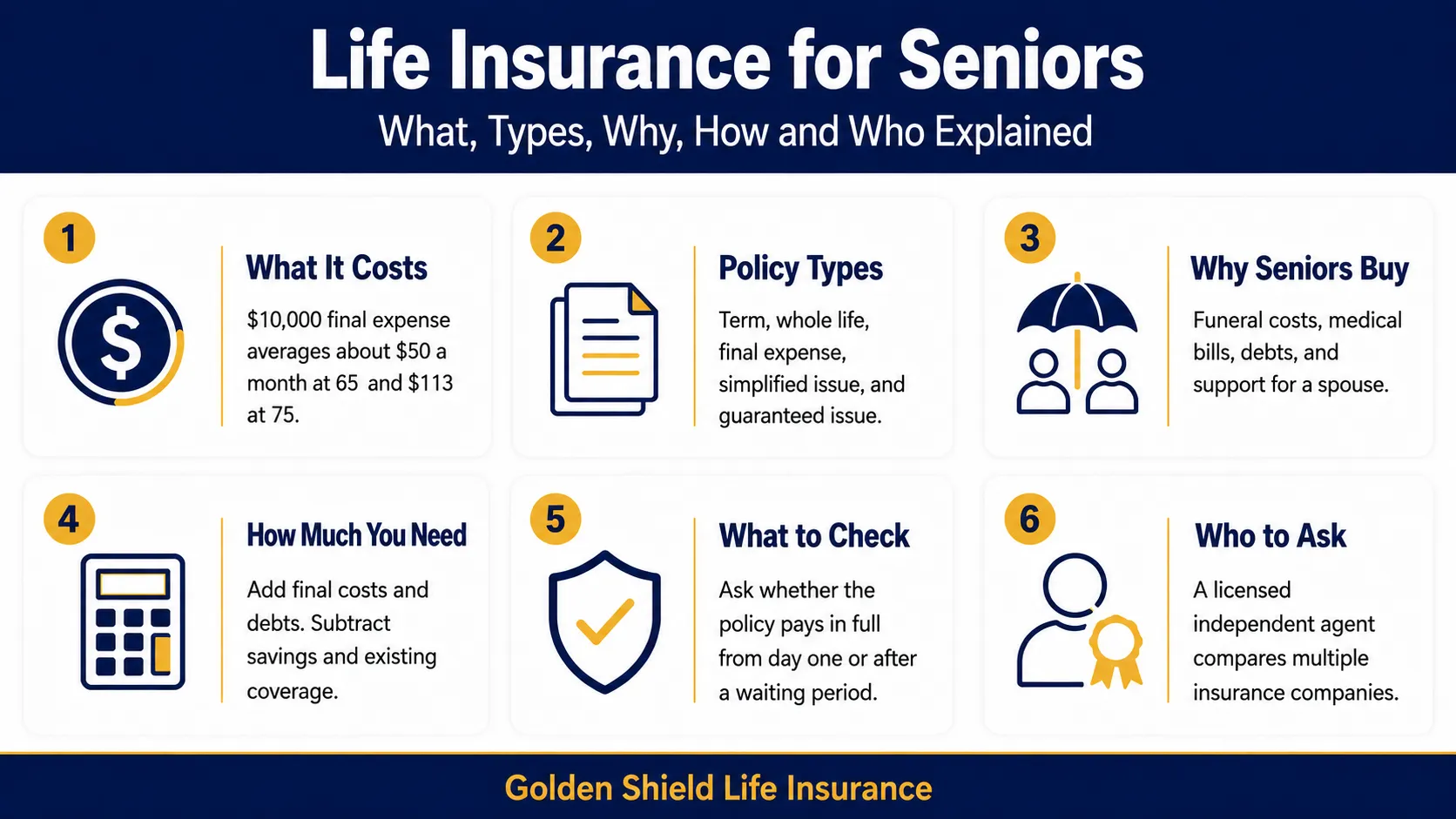
Senior life insurance overview covering what it costs, policy types, why seniors buy coverage, how much coverage is needed, what to check before signing, and working with a licensed independent agent
This overview covers six things a senior buyer should know. What it costs: a $10,000 final expense policy averages about $50 a month at 65 and about $113 at 75. Policy types: term, whole life, final expense, simplified issue, and guaranteed issue. Why seniors buy: funeral costs, medical bills, remaining debts, and support for a surviving spouse. How much you need: add up what would be owed, then subtract savings and coverage already in force. What to check: whether the policy pays in full from day one or only after a waiting period. Who to ask: a licensed independent agent who compares multiple insurance companies.
Illustrative averages from MoneyGeek and the NFDA, 2026. Not an offer of coverage. Your rate depends on underwriting.
Golden Shield Life Insurance branded van at a client's home in Metro Atlanta
Aaron Polk, founder and licensed agent at Golden Shield Life Insurance

Written and Reviewed By

Aaron Polk

Founder and Licensed Life Insurance Agent and Broker, Golden Shield Life Insurance
Former National Medical Underwriter · Georgia License 3710928 · NPN 21216745 · Georgia Agency License 242517

Aaron Polk was raised in a small business family by a father who served as a U.S. Army Green Beret. He got into life insurance after his father was almost scammed by a fake final expense company. Today Golden Shield Life Insurance has a team of licensed agents and an office in Atlanta where clients can meet in person, and it helps seniors across the country by phone and video. He compares more than 130 insurance companies rated A- or better by AM Best, with a focus on older applicants and people other agents pass over.

How this guide was made: Written by a licensed agent from first-hand casework, not compiled from other insurance websites. Every rate figure on this page carries the publisher and the date it was published so you can check it yourself. Funeral cost figures, tax treatment, and government benefits are checked against the numbered references in the disclaimer below, each of which is linked. Named plan details, such as issue ages, coverage limits, benefit schedules, and riders, come from each insurance company's consumer brochure or public product page, checked November 2026. Agent-only materials are not quoted. Terms are confirmed again at the time of quoting.

Disclaimer

Updated November 2026

  • This page is educational and is not financial, legal, or tax advice.
  • Every rate figure on this page and in the overview graphic is an illustrative third-party average, not a quote. Each carries its publisher and publication date where it appears. Your rate depends on underwriting.
  • Coverage, pricing, riders, issue ages, and product availability vary by insurance company, state, age, health, and policy terms.
  • Golden Shield Life Insurance does not promise approval, pricing, or benefit eligibility.
  • Where a plan is named, its issue ages, limits, and benefit schedule come from that company's consumer materials. Other ranges on this page are general industry ranges. Neither is an offer of coverage. The policy contract controls.
  • Baltimore Life iProvide™ Whole Life details are summarized from the carrier's consumer brochure (Form 9063A-0724). iProvide is underwritten and issued by The Baltimore Life Insurance Company, Owings Mills, Maryland. The brochure is not a contract. Product and riders are not available in all states, and the policy and riders control.
  • Mutual of Omaha Living Promise and Banner Life OPTerm details are summarized from each company's consumer brochure. Living Promise is underwritten by United of Omaha Life Insurance Company. OPTerm is issued by Banner Life Insurance Company. Foresters PlanRight is issued by The Independent Order of Foresters. Corebridge Guaranteed Issue Whole Life is issued by American General Life Insurance Company. Brochures are not contracts, and the policy controls.
  • The Best Life Insurance Companies for Seniors section reflects Golden Shield Life Insurance's own selection criteria: cost, benefit for the face amount, ease of approval, and an AM Best rating of A- or better for the issuing company. It is not a ranking by any rating agency. The best fit for any one person depends on age, health, state, and the amount needed. Golden Shield Life Insurance is appointed with and paid a commission by the insurance companies it represents.
  • The client example of a $100,000, 20-year term policy at about $200 a month reflects one individual's age, health, and underwriting result. It is not a quote, and your premium may be higher or lower.
  • Statements that life insurance death benefits are generally income tax-free are based on IRS guidance (reference 19). Interest paid on proceeds may be taxable, and estate tax rules may apply. Consult a tax professional about your situation.
  • Guaranteed acceptance waiting periods described on this page are general industry terms. The plans named on this page use a two-year period. Some policies use other schedules, so read the benefit schedule in your policy.
  • Permanent life insurance cash value grows over time and is not added to the death benefit on most policies. Indexed universal life does not invest directly in the stock market; interest credits are subject to caps, floors, participation rates, and policy charges. Universal life policies can lapse if cash value is not enough to cover policy costs.
  • Fixed annuities are not life insurance, are not FDIC insured, and may carry surrender charges for early withdrawals. Withdrawals may be taxable, and withdrawals before age 59½ may carry an IRS penalty. Annuity statements on this page are educational (reference 20).
  • Buying life insurance on a parent requires the parent's knowledge, consent, and signature, and an insurable interest as defined by state law and the insurance company.
  • Named senior plans and their published limits come from each company's consumer brochure: Mutual of Omaha Living Promise (128136_0323), Baltimore Life iProvide (9063A-0724), Banner Life OPTerm (LAA2233), and Corebridge Financial. A listed limit is the most a plan allows, not what every applicant can get. Ages and limits vary by state, health, and tobacco use. Checked November 2026.
  • The $10,000 final expense averages by age are from MoneyGeek, data updated June 11, 2026, for non-tobacco applicants (reference 1). They are averages, not quotes. Prices rise fastest between 75 and 80.
  • The average premiums by policy type are from MoneyGeek, data updated July 6, 2026, for non-tobacco applicants in average health (reference 2). They are averages, not quotes or an offer of coverage.
  • Waiting period and living benefit examples are drawn from NAIC consumer guidance and the Mutual of Omaha, Baltimore Life, Banner Life, and Foresters consumer materials (references 6, 12, 13, 14, and 15).
  • Graded and modified benefit plans may pay less than the full death benefit during an initial period. Refund amounts and interest rates vary by policy. Read the benefit schedule in your policy.
  • Health conditions listed on this page are grouped as general underwriting tendencies. No condition automatically qualifies or disqualifies anyone, and different insurance companies reach different conclusions on the same file.
  • Funeral and cremation figures cited are national medians from the National Funeral Directors Association and vary widely by region, provider, and the services chosen.
  • Living benefits availability depends on the policy and qualifying conditions. Using a living benefit early lowers the death benefit and any cash value, and it is not long-term care insurance.
  • Policy loans and withdrawals may reduce the death benefit and may have tax consequences.
  • Any benefit payment depends on the issuing insurance company and the terms of the policy.
  • Tax treatment may change and depends on your situation. Consult a qualified tax professional.
  • The coverage amounts table and example worksheet are educational illustrations only, not a recommendation of any amount.
  • Client testimonials reflect the experience of individual clients and are not a promise of any particular result.
  • Golden Shield Life Insurance is appointed with the insurance companies it represents and is paid a commission when a policy is placed.
  • Outbound links are provided for reference. Golden Shield Life Insurance does not control and is not responsible for third-party content, including any sponsorships or advertising those sites carry.

Named Senior Plans and Published Limits

From each company's consumer brochure, checked November 2026. A listed limit is the most a plan allows, not what every applicant can get.
PlanTypeIssue AgesCoverageFirst Two Years
Mutual of Omaha Living Promise LevelWhole life, final expense45 to 85$2,000 to $50,000Full benefit from day one
Mutual of Omaha Living Promise GradedWhole life, final expense45 to 80$2,000 to $20,000Premiums back plus 10% for a natural death
Baltimore Life iProvideWhole life, final expense45 to 89$2,500 to $50,000Full benefit (Preferred, Standard), or 110% of premiums (Modified)
Banner Life OPTermTerm life10 and 15-year to 75; 20-year to 70From $100,000Full benefit from day one
Corebridge Guaranteed Issue Whole LifeWhole life, guaranteed issue50 to 80$5,000 to $25,000110% of premiums for a natural death

Product Availability by Age

Quoting guide from the consumer brochures above, checked November 2026. Ages and limits vary by state, health, and tobacco use.
AgeTerm LifeWhole Life and Final Expense
60 to 6910 and 15-year term through 75; 20-year term through 70, non-tobacco (Banner OPTerm)Widely available, with or without an exam
70 to 7410 and 15-year term until 75; 20-year term usually closedSimplified issue up to $50,000 (Living Promise 45 to 85, iProvide 45 to 89)
75 to 79New term usually ends at 75Final expense and whole life; Living Promise Graded through 80 if health rules out a level plan
80 to 84Not available on plans we useSimplified issue up to $50,000 listed; premium usually decides the amount; Corebridge guaranteed issue through 80
85 to 89Not available on plans we useBaltimore Life iProvide through 89, $2,500 to $50,000
90 and olderNot available on plans we useNo plan in our carrier documents accepts new applicants; check coverage in force or a preneed plan

Free Guides and Brochures (PDF)

References

  1. 1MoneyGeek. Final expense insurance cost research. Supports the $10,000 final expense monthly averages shown by age from 55 through 85, including the point that the sharpest increase falls between ages 75 and 80. Non-tobacco applicants. Data updated June 11, 2026. moneygeek.com final expense cost
  2. 2MoneyGeek. Senior life insurance rate research. Supports the cost-by-policy-type table comparing term, no-exam term, final expense, and guaranteed issue at ages 55, 65, and 75, and the $100,000 ten-year term figures cited in the FAQ. Non-tobacco applicants in average health. Data updated July 6, 2026. moneygeek.com senior rates
  3. 3NerdWallet. Average life insurance rates. Supports the $500,000 twenty-year term figures cited for a seventy-year-old applicant in the FAQ. Data valid as of February 13, 2026. nerdwallet.com average rates
  4. 4National Funeral Directors Association. Member General Price List Study. Supports the national median cost of a funeral with viewing and burial, the figure with a vault, and the median for a funeral with cremation. None of these include a cemetery plot or headstone. 2023 study, data last updated September 29, 2025. nfda.org/news/statistics
  5. 5Social Security Administration. Survivors benefits and the actuarial life table. Supports the point that household Social Security income changes when one benefit ends, and the actuarial basis for age-based pricing. Accessed August 2026. ssa.gov survivors · actuarial life table
  6. 6NAIC, National Association of Insurance Commissioners. Consumer guidance on life insurance. Supports the whole life and cash value framework behind final expense, the description of graded and modified benefit structures, the definition of insurable interest, and beneficiary designation basics. Accessed August 2026. content.naic.org consumer guide · NAIC Life Insurance Buyer’s Guide (PDF)
  7. 7MIB Group. Medical Information Bureau. Supports the point that no-exam applications may still be checked against prescription records and prior insurance application data. Accessed August 2026. mib.com
  8. 8Georgia Office of Insurance and Safety Fire Commissioner. Life insurance consumer resource and the public agent and company search. Supports the guidance to verify an agent's license before sharing personal or financial information, and to weigh final expenses and outstanding debts when deciding how much coverage to buy. The same office takes consumer complaints and fraud reports. Accessed August 2026. life insurance resource · agent and company search · complaints and fraud
  9. 9AM Best. Insurer financial-strength rating lookup. Supports the A- or better standard referenced on this page and the guidance to check whether an insurance company is rated before you apply. Accessed August 2026. ambest.com
  10. 10Federal Trade Commission. "Funeral Costs and Pricing Checklist" and "The FTC Funeral Rule." Supports your right to itemized funeral pricing before you agree to anything, which is the practical way to size the final expense number used in the coverage worksheet. Updated March 2024. pricing checklist · funeral rule
  11. 11NAIC Life Insurance Policy Locator. A free national tool that helps families search for a deceased relative's lost life insurance policy and connect with unclaimed death benefits. There is no cost to use it and no need to contact us first. Accessed August 2026. eapps.naic.org life policy locator
  12. 12Mutual of Omaha. Living Promise whole life consumer brochure, form 128136_0323. Supports the Level plan (ages 45 to 85, $2,000 to $50,000), the Graded plan (ages 45 to 80, $2,000 to $20,000, premiums plus 10% for a natural death in years 1 and 2), and the terminal illness and nursing home accelerated death benefit. Underwritten by United of Omaha Life Insurance Company. Checked November 2026. mutualofomaha.com
  13. 13The Baltimore Life Insurance Company. iProvide Whole Life consumer brochure, Form 9063A-0724. Supports issue ages 45 to 89, coverage from $2,500 to $50,000, the Preferred, Standard, and Modified benefit schedules, the accelerated death benefit of up to 75%, the $1,000 cash draft, and premium options. Checked November 2026. iProvide brochure (PDF) · baltlife.com
  14. 14Banner Life Insurance Company, a Legal & General America company. OPTerm consumer brochure, LAA2233 18-295. Supports issue ages, conversion terms, and the included accelerated death benefit rider. This brochure carries a 2018 form date, so terms are confirmed at quoting. Checked November 2026.
  15. 16The Baltimore Life Insurance Company. Silver Guard Simplified Issue Senior Life Insurance consumer brochure, Form M-8660-1021. Supports the Silver Guard description: simplified issue whole life with health questions and no exam, level premiums, an accelerated death benefit for terminal illness at no extra cost, and an optional accidental death rider. Checked November 2026. Silver Guard brochure (PDF)
  16. 17The Baltimore Life Insurance Company. Memorial Planning Guide, Form 3441-0425. A free planner for recording final wishes, accounts, and policy details for your family. Checked November 2026. Memorial Planning Guide (PDF)
  17. 18Ethos. Ethos life insurance for seniors consumer page and Ethos term life consumer brochure. Supports the Ethos description: online applications with no medical exam, term life for eligible applicants ages 20 to 85, including seniors, and guaranteed issue whole life for ages 65 to 85. Ethos is a distribution platform, and policies are issued by partner insurance companies. Checked November 2026. ethos.com/seniors · Ethos term life brochure (PDF) · Folleto en español (PDF)
  18. 19Internal Revenue Service. Life Insurance and Disability Insurance Proceeds, frequently asked tax questions. Supports the statement that life insurance proceeds paid to a beneficiary because of the insured person's death are generally not included in gross income, while any interest paid on those proceeds is taxable. Checked November 2026. irs.gov life insurance proceeds FAQ
  19. 20NAIC, National Association of Insurance Commissioners. What You Should Know Before Buying an Annuity. Supports the fixed annuity statements on this page, including tax deferral, surrender charges for early withdrawals, and free look periods. Checked November 2026. NAIC annuity guide (PDF)
  20. 15Foresters Financial. PlanRight consumer brochure, 503340 US 06/25. Supports the PlanRight Basic schedule: premiums paid plus 10% annual interest for a non-accidental death in the first two years, and the full benefit for an accidental death. Issued by The Independent Order of Foresters. Checked November 2026. foresters.com PlanRight brochure

Helpful Links