Mortgage protection insurance is life insurance designed to help a homeowner or family keep up with mortgage payments, pay off a home loan, or cover other household expenses after a death. Depending on the policy, coverage may also include living benefits for qualifying illnesses or health events while you are alive. This guide explains how mortgage protection insurance works, what it costs, who may qualify, how term and permanent policies can be used, and how it differs from private mortgage insurance (PMI). Golden Shield Life Insurance compares options from multiple carriers so homeowners can review coverage, rates, underwriting, and policy features before applying.
Golden Shield Life Insurance can help you compare policies across carriers to find options that may fit your mortgage, health, and family goals.
Written By:
Licensed & Reviewed
Aaron PolkAaron Polk, CEO and founder of Golden Shield Life Insurance, helps individuals and business owners secure custom life insurance, mortgage protection, and income replacement strategies.
Connect on LinkedIn
Mortgage Protection InsuranceLife insurance that can help cover your mortgage after death or certain qualifying events, such as a terminal, critical, or chronic illness, depending on the policy.
No cost, no obligation. No-exam options may be available for qualified applicants.
Mortgage Protection Insurance Buyer's Guide
A 30-second orientation before the details below.
How to Shop It. Compare the coverage amount, policy term, premium, underwriting, and available living benefits across multiple carriers.
How to Use It. Choose coverage that could help pay off the mortgage, continue monthly payments, or give your beneficiaries money for other household needs.
How Claims Work. For a death claim, the beneficiary generally contacts the carrier and submits the required claim form and death certificate. Living-benefit claims require documentation showing the policy's qualifying conditions have been met.
How It Is Generally Taxed. Life insurance death benefits paid to a beneficiary are generally not included in federal taxable income, although exceptions can apply and interest paid on proceeds is taxable.2 This is general information, not tax advice.
What Is Mortgage Protection Insurance?
Mortgage protection insurance is life insurance structured to help protect a household's mortgage obligation if the insured dies. Depending on the policy design, the benefit may pay down the mortgage directly or be paid to a beneficiary, who can use it for the mortgage and other household needs. Some policies may include optional living-benefit features for qualifying illnesses.
Mortgage protection is a coverage goal, not always the formal name of one specific policy. Homeowners may use mortgage life insurance, decreasing term life insurance, or level term life insurance to address that goal.3
Editor's Note
Mortgage protection is one type of insurance I wish more homeowners understood before they needed it. Many people buy a home and assume the mortgage insurance included with their loan is there for them. In reality, PMI generally covers the lender's risk, not the homeowner or the family. Mortgage protection takes a different approach. It uses life insurance to provide money for your family if you die, and some policies may also pay benefits while you are living if a qualifying illness or major health event changes your situation. For me, the goal is simple: understand what you have, what it actually does, and whether there is a gap.
Key Takeaways
It is a goal, not a single product. Decreasing term, level term, return-of-premium term, and certain permanent policies can all be used to address a mortgage need.
Who receives the money varies. Some mortgage-specific policies may pay the lender. An individually owned term policy generally pays the beneficiary you name.
May include living benefits. Some policies may let you access part of the death benefit after a qualifying terminal, chronic, or critical illness, depending on the policy and rider.
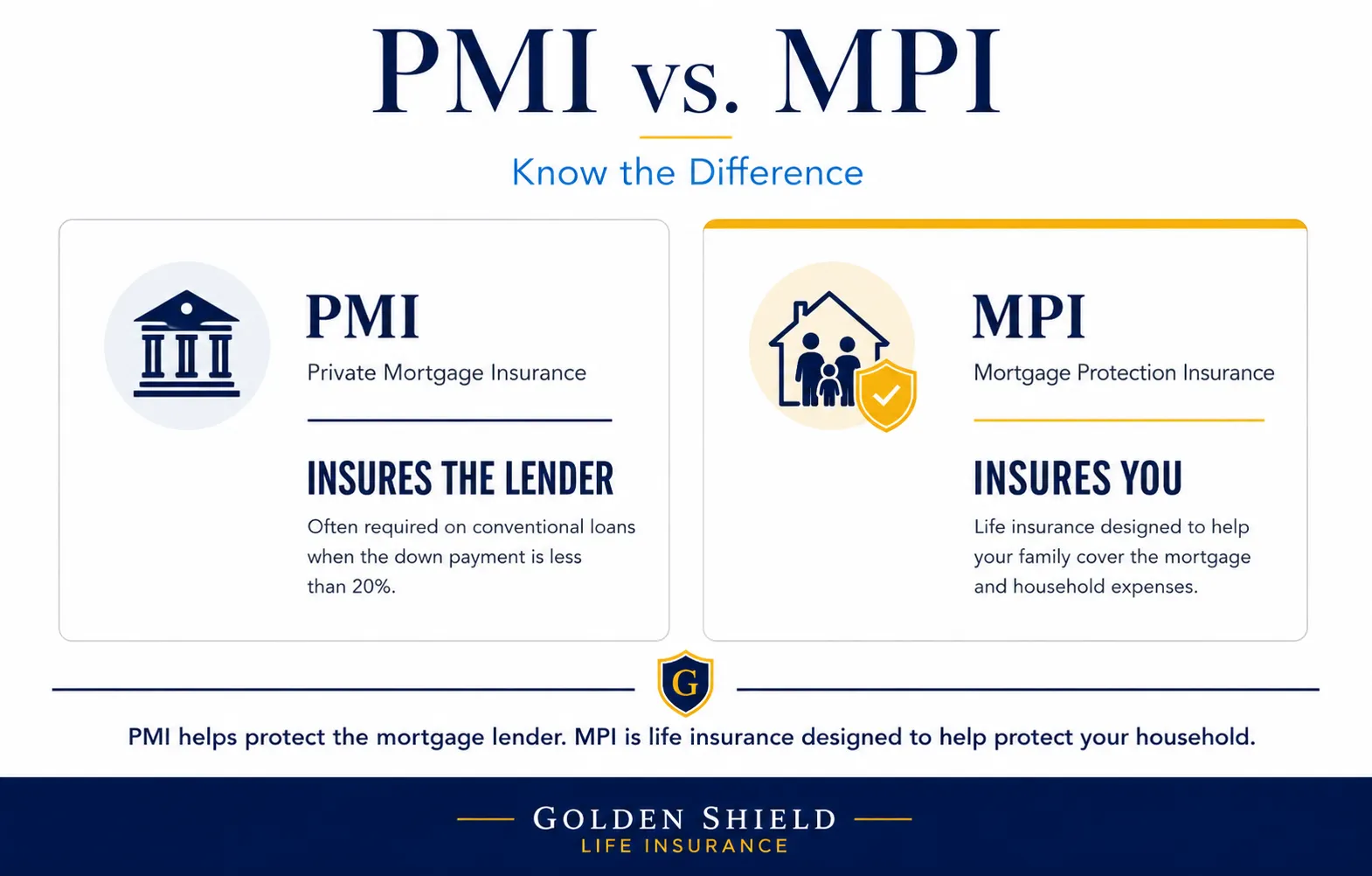
It is not PMI. Private mortgage insurance primarily covers the lender if the borrower stops making payments. With conventional mortgages, PMI is commonly required when the down payment is less than 20 percent.1
◆How It Works
How Mortgage Protection Insurance Works
Determine your goal: Decide whether the policy should pay off the entire mortgage balance, cover monthly payments for a fixed period, or provide broader income replacement for your household.
Select the structure:
Decreasing coverage: The death benefit steps down over time as your loan balance declines.
Level coverage: The death benefit stays fixed for the full term, leaving extra funds for other living expenses as your mortgage balance falls.
Name the insured and beneficiary: If the insured dies during the policy term, the insurer pays the death benefit. Depending on the policy type, the payout goes either directly to the mortgage lender or to a named beneficiary.
Consider living benefits: Certain policies may allow you to access a portion of the death benefit while living if you face a qualifying critical, chronic, or terminal illness.
Private mortgage insurance and mortgage protection insurance are different products that cover different people.
Mortgage Protection Insurance vs PMI, Explained
A short walkthrough of the difference between private mortgage insurance and mortgage protection insurance, who each one actually pays, and why that distinction matters for your household.
Video transcript
[TRANSCRIPT PARAGRAPH 1]
[TRANSCRIPT PARAGRAPH 2]
[TRANSCRIPT PARAGRAPH 3]
Expert Insight
Before my accident, I was offered mortgage protection coverage and turned it down. I said I would get it later. Thirty days later I was permanently disabled.
Under the coverage I had been offered, the qualifying disability benefit could have paid off my home. That is why I do not treat this as death benefit only coverage.
Here is where people get tripped up. Living benefits, disability income riders, waiver-of-premium riders, and mortgage-payment disability coverage are four different features, and they do four different things. What is available, how much it pays, how long you wait, and what actually counts as qualifying all change by carrier and by policy.
I read that section of the contract with a client before anyone signs anything. Ask what a policy may do while you are still living, and what it requires, before you decide.
Mortgage protection insurance may be worth considering if your household would have a hard time keeping up with the mortgage after a death, serious illness, or qualifying disability.
Let's Get Started
Shop, compare, and apply in minutes, often with no medical exam. No cost, no obligation.
Premiums are based on the coverage you buy and the person insured, not on the value of the home. Two homeowners with the same mortgage can pay very different rates.
Key Cost Factors
Coverage amount: Premiums are based on the face amount you buy, which usually starts with your remaining mortgage balance. Larger amounts generally cost more.
Policy term length: A 30-year term generally costs more per month than a 15-year term, because the carrier is covering a longer period.
Age, health, and tobacco use: These drive the underwriting class, which is often the largest single factor in the premium.4
Underwriting path: Simplified or no-exam coverage may cost more than fully underwritten coverage for applicants in good health.
Optional riders: Disability-related riders and similar features, where available, generally increase the premium.
How much is mortgage protection insurance on $250,000?
There is no single rate for a $250,000 mortgage. The same coverage amount can price very differently depending on your age, health, tobacco use, the term you choose, and the carrier. A healthy applicant in their thirties buying a 20-year term generally pays a fraction of what an applicant in their fifties pays for the same amount.
How much is mortgage protection insurance on a $400,000 house?
A $400,000 home does not automatically call for $400,000 of coverage. The usual starting point is what you still owe, plus anything else you want the money to handle. A homeowner who owes $180,000 on a $400,000 home may only need coverage for the $180,000 balance, which costs considerably less than insuring the full purchase price.
Rate examples on this site are for educational purposes only. They are not a quote or an offer of coverage. Actual premiums vary by carrier, state, age, health, tobacco use, underwriting class, coverage amount, term, and policy structure. Final pricing is determined only after underwriting and carrier approval.
1
Once you know what the policy needs to cover, compare real quotes across carriers rather than estimating from an average.
◆Choosing Your Coverage
Types of Life Insurance Used for Mortgage Protection
Different life insurance policies can address a mortgage in different ways. The right option depends on whether you want coverage to decrease as the loan is paid down, remain level, return eligible premiums, or continue beyond the mortgage.
There are two broad categories to choose from: term life insurance and whole life insurance. These policies work differently, and in some cases they can be combined. Talking through the options with a licensed agent is the best way to decide which structure fits your situation.
Decreasing Term Life Insurance
How it works: The death benefit decreases over a set period as the mortgage is paid down.
Trade-off: The insurance benefit may not match the mortgage amortization schedule dollar-for-dollar. Early in a loan, more of each payment goes toward interest, so the mortgage balance may decline more slowly than the policy benefit.
Level Term Life Insurance
How it works: The death benefit remains the same for a selected period, such as 20 or 30 years.
Why it matters: As the mortgage balance falls, the difference between the loan balance and death benefit can grow. With an individually owned policy, the named beneficiary generally decides whether to use the benefit for the mortgage, income replacement, childcare, debts, or other household needs.
Return-of-Premium Term Life Insurance
How it works: Provides term coverage with a feature that may return eligible premiums if the insured outlives the policy term and applicable requirements are met.
Trade-off: It generally costs more than comparable traditional term insurance. Homeowners can compare the higher premium with the lower cost of traditional term coverage.
Permanent Life Insurance
How it works: Whole life and certain universal life policies can provide coverage beyond the mortgage term and may build cash value over time.
Why it matters: Permanent coverage generally costs more than term insurance but may fit homeowners with financial needs extending beyond the mortgage, such as lifelong dependents, legacy planning, or business obligations.
Before You Refinance, Sell, or Move
Coverage tied directly to a mortgage may be affected if you refinance, sell the home, or pay the loan off early. An individually owned term life policy is generally separate from the mortgage and does not automatically end when you move or refinance. Review the policy terms before assuming how a change to your mortgage will affect coverage.
Who Qualifies for Mortgage Protection Insurance?
Eligibility depends on the policy, carrier, age, health, tobacco use, coverage amount, and term selected. Underwriting can range from a few health questions to a more detailed medical review.
One point deserves emphasis. No medical exam does not mean no underwriting. Carriers that skip the exam may still review health questions, prescription history, medical information databases, motor vehicle records, and other available data before making a decision.5 Approval, the rate class, and the final premium are all subject to that review.
Simplified Issue
Simplified-issue policies typically use health questions and electronic records instead of a traditional medical exam. Approval is still subject to carrier underwriting.
Accelerated or No-Exam Underwriting
Some applicants may qualify without blood work or an exam. Carriers may use prescription history, medical databases, driving records, and other available information to make an underwriting decision.
Fully Underwritten
Fully underwritten coverage may include medical records, lab testing, or a paramedical exam. It can take longer, but healthy applicants may qualify for more favorable rates.
Expert Insight
The easiest application is not always the lowest-cost option. Comparing carriers can help identify the underwriting path that fits your health, budget, and coverage needs.6
Aaron Polk, Founder
◆Before You Buy
Downsides of Mortgage Protection Insurance
Shrinking payouts: With a decreasing policy, the death benefit goes down as you pay off your loan, while the premium generally stays level.
Less choice for families: Many mortgage-specific policies send the money straight to the lender rather than to your family. Your family may not be able to decide how it is used.
Higher prices for healthy people: Skipping a medical exam often makes this coverage more expensive than standard term life insurance if you are in good health.
Tied to your home loan: If you sell your home, move, or refinance, coverage tied to that loan may end or need to be changed. Treatment varies by policy, so check before you assume.
Using benefits early reduces the final payout: If you access money while you are still living, there is generally less left for your beneficiaries later.
Living benefits have conditions: The policy's qualifying requirements have to be met, and documentation is required. These are not general-purpose emergency funds.
Living Benefits with Mortgage Protection Insurance
Some policies may let you use a portion of your death benefit early if you become seriously ill. Instead of going to the lender, that money generally goes to you, so it can be applied to mortgage payments, household bills, or medical costs.
Terminal Illness
May provide access to part of the death benefit early if a doctor diagnoses an illness that meets the policy's definition of terminal.
Chronic Illness
May pay benefits if you become unable to perform daily activities such as bathing or dressing, or if you meet the policy's requirements for severe cognitive impairment.
Critical Illness
May pay benefits after a qualifying diagnosis such as a heart attack, stroke, or certain cancers listed in the policy.
Living Benefits vs. Disability Add-Ons
People often use these terms interchangeably, but they are four different features that do four different things.
Living benefits may let you take money from your death benefit early after a qualifying illness. The amount you use generally reduces what is left for your beneficiaries.
A disability income rider may pay you regular income if you meet the policy's definition of disability. It generally does not reduce the death benefit, though terms vary by policy.
Waiver of premium may cover your policy premiums for you if a qualifying disability keeps you from working, which keeps the coverage in force at the moment your income has stopped.
Mortgage-payment disability coverage may cover a set mortgage payment amount for a limited period after a qualifying disability, where available.
These features depend on your state and the carrier's rules. They are optional riders or policy features, not separate insurance policies, and the qualifying conditions, benefit amounts, waiting periods, costs, and availability all vary. Ask which ones a policy actually includes before you decide.
Priscilla's Story
Mortgage Protection with Term Life Insurance and IUL
I highly recommend Golden Shield Life Insurance to anyone looking for term life coverage. They offer some of the best rates and excellent service.
Common Questions
Mortgage Protection Insurance FAQ
What does mortgage protection insurance cover?
Mortgage protection insurance is life insurance arranged around your home loan. It is designed to pay a death benefit if the insured dies while eligible coverage is active, and that money may be used to pay off the mortgage or keep up the monthly payments. If the policy includes living benefit riders, it may also allow early access to part of the death benefit after a qualifying disability or serious illness. What is covered depends on the insurer, the policy, and the riders selected, subject to underwriting and policy terms.
Can a 70-year-old get mortgage protection insurance?
Yes, a 70-year-old may still qualify. Coverage at that age is often written as a 10 or 15 year term policy, or as whole life, depending on the insurer. Premiums are generally higher at older ages, and the options available depend on health, the coverage amount, and each insurer's underwriting rules.
Is mortgage protection insurance the same as PMI?
No. Private mortgage insurance, or PMI, is usually required by the lender when a conventional down payment is less than 20 percent, and it covers the lender if the borrower defaults. Mortgage protection insurance is optional life insurance that you own, and it is designed to pay a benefit to your beneficiary or toward the loan if you die. Some policies also include living benefit riders that may allow early access to part of the death benefit after a qualifying event.
Can I use term life insurance to pay off my mortgage?
Yes. Term life insurance is often the lowest cost way to buy a set amount of coverage for a set number of years, which is why it is commonly used for a mortgage. Some carriers offer accelerated underwriting that may waive the medical exam for qualifying applicants, though coverage limits, age ranges, and turnaround times vary by insurer. A carrier may still ask for a phone interview to confirm the information on your application. When an exam is required, it is generally paid for by the insurer, and a fully underwritten policy may qualify for a lower rate than a no exam option.
Is mortgage protection insurance required?
No. A lender may require private mortgage insurance or homeowners insurance, but mortgage protection life insurance is optional and privately owned. If the policy includes living benefit riders, it may allow early access to part of the death benefit after a qualifying event such as a covered critical, chronic, or terminal illness, when the condition meets the policy definition. Whether the coverage makes sense depends on your mortgage balance, your savings, and who depends on your income.
★★★★★
“Aaron Polk is the best. He listens, explains everything clearly, and truly cares about helping his clients. I highly recommend him.”
One of the most important things to understand is that Mortgage Protection Insurance is not necessarily a specific policy name. It describes the purpose of the coverage. The goal is to structure life insurance around your mortgage and financial responsibilities so there is a plan in place if the unexpected happens.
For many homeowners, term life insurance for mortgage protection can provide a flexible way to match coverage to the balance and remaining years on a home loan. That may mean choosing level term life insurance, where the death benefit stays the same, or decreasing term insurance, where the benefit gradually declines as the mortgage balance falls. Decreasing coverage is sometimes referred to as mortgage reducing term assurance.
At Golden Shield Life Insurance, we focus on the purpose first, then compare the policies and carriers that may help accomplish it. We look at:
Mortgage balance and the years remaining on the loan
Amount of coverage your household may need
Level versus decreasing term coverage
Living benefits and riders that may be available
Underwriting requirements and pricing
Multiple insurance companies and policy options
An individually owned life insurance policy may also give your beneficiary more flexibility. The benefit could be used toward the mortgage, property taxes, insurance, household expenses, debt, or other financial needs rather than being limited to one obligation.
Before choosing coverage, understand who owns the policy, who receives the benefit, whether premiums can change, whether coverage stays level or decreases, and what qualifying living benefits may be available.
My goal with this guide is not to put every homeowner into the same type of policy. It is to help you understand what mortgage protection insurance is meant to accomplish, compare the available ways to structure it, and build a plan around your home, budget, family responsibilities, and long-term goals.
Your mortgage may last 10, 20, or 30 years. Mortgage protection is about acknowledging that commitment and having a financial plan in place if life does not unfold exactly as expected.
Aaron Polk
Founder, Golden Shield Life Insurance
Your shield is ready. Are you?
Thank you. Your request is in. A licensed agent at Golden Shield Life Insurance will reach out shortly to match you with your options.
Something went wrong sending your request. Please try again, or call or text us at 678-884-4653.
Disclaimers
Written and Reviewed By
Aaron Polk
Founder and Licensed Life Insurance Agent, Golden Shield Life Insurance · NPN 21216745
Golden Shield Life Insurance · Georgia Agency License 242517
Aaron founded Golden Shield Life Insurance after a 2007 accident showed him how fast a steady life can change. He compares options from multiple carriers to help families find honest coverage, with a focus on people other agents pass over. Carrier access and availability vary by product, state, applicant profile, and underwriting.
Last reviewed: . Reviewed by Aaron Polk, Licensed Life Insurance Agent. This page is reviewed and updated as products, tax rules, and carrier practices change.
DisclaimersView
Facts on This Page Are Supported By
1Consumer Financial Protection Bureau. "What is private mortgage insurance?" Supports the statement that PMI covers the lender rather than the borrower, and that it is commonly required on conventional loans when the down payment is less than 20 percent. Accessed August 2026. consumerfinance.gov
2Internal Revenue Service. Publication 525, Taxable and Nontaxable Income, and "Life Insurance & Disability Insurance Proceeds." Supports the general federal income-tax treatment of life insurance death benefits described on this page, including the treatment of interest paid on proceeds. Accessed August 2026. irs.gov/publications/p525 · irs.gov FAQ
3Wikipedia, Mortgage Life Insurance. Supports the description of mortgage life insurance as coverage arranged around a home loan, including decreasing term designs and policies in which the lender may be named as beneficiary. Accessed August 2026. en.wikipedia.org/wiki/Mortgage_life_insurance
4Social Security Administration. Actuarial Life Table. Supports how mortality risk rises with age, which is a primary driver of age-based life insurance pricing. Accessed August 2026. ssa.gov/oact/STATS/table4c6.html
5MIB Group. Confidential coded underwriting data shared among member insurance companies. Supports the statement that carriers may review medical information databases and other available records even when no medical exam is required. Accessed August 2026. mib.com
6NAIC, National Association of Insurance Commissioners. "Tips for Buying Life Insurance" and the NAIC Life Insurance Buyer's Guide. Supports comparing policies across insurers and matching benefits to your own financial needs before buying. Accessed August 2026. content.naic.org
7AM Best. Insurer financial-strength rating lookup. Financial-strength ratings are one factor consumers may consider when evaluating an insurer. Ratings are the opinion of the rating agency, may change over time, and do not assure that a claim will be paid. Accessed August 2026. ambest.com
8Insurance Information Institute. Facts and Statistics: Life Insurance. General reference for U.S. life insurance ownership, coverage, and industry data. Accessed August 2026. iii.org
Disclaimers
This page is educational and is not financial, legal, or tax advice.
Mortgage protection insurance is not private mortgage insurance (PMI). PMI covers the lender. The coverage described on this page is life insurance.
Coverage, pricing, riders, and product availability vary by carrier, state, age, health, and policy terms.
Golden Shield Life Insurance cannot promise approval, pricing, or benefit eligibility. All coverage is subject to carrier underwriting.
Living benefits are optional riders or policy features, not separate insurance policies. Qualifying conditions, benefit amounts, waiting periods, costs, and availability vary.
Accessing a living benefit generally reduces the death benefit available to your beneficiaries.
Coverage tied directly to a mortgage may be affected if you refinance, sell the home, or pay the loan off early. Review the policy terms before assuming how a change to your mortgage affects coverage.
No medical exam does not mean no underwriting. Carriers may still review health questions, prescription history, and other available records.
Any benefit payment depends on the issuing insurer and the terms of the policy.
Tax treatment may change and depends on your situation. Consult a qualified tax professional.
 Aaron Polk
, CEO and founder of Golden Shield Life Insurance, helps individuals and business owners secure custom life insurance, mortgage protection, and income replacement strategies.
Connect on LinkedIn