Welcome back to the explainer. So, today we're diving straight into something that usually makes people groan: life insurance. Specifically, we're talking about getting it without the dreaded medical exam. If you've been kicking the can down the road because you literally just don't have the time or the patience for the old-school process, you're in the right spot. Let's get right into it.
Be honest for a second. When you think about life insurance, what's the first thing that pops into your head? For a lot of us, it's a stranger showing up at the house, the super uncomfortable physical, the blood draw, the little plastic cup, and then weeks of just waiting around in the dark for an underwriter to get back to you. Honestly, that physical invasion and the massive time drain are huge deterrents.
It's a massive pain point, and it keeps so many people totally unprotected. And guys, the scale of this problem is just staggering. Roughly 100 million Americans say they either need life insurance or they need more of it. Think about that. That is a massive chunk of the population just walking around without a safety net for their loved ones.
But here's the good news. The industry has actually evolved. Getting an application done and getting a decision fast is completely possible now. There's basically a modern life hack to bypass that physical exam entirely.
So here's our road map for today's explainer. One, the no-exam reality. Two, the invisible medical exam. Three, three ways to qualify. Four, breaking down the costs. And five, smart shopping and advice.
The No-Exam Reality
All right, section one, the no-exam reality: busting the biggest myth. Okay, so the absolute most crucial thing to understand right out of the gate is this. No medical exam is not a product. It describes how you're evaluated, not what you're actually buying. You are not getting some lesser, watered-down policy just because you skip the doctor's visit. The actual coverage is exactly the same. You can still get term, whole life, or final expense insurance.
The whole point of the insurance hasn't changed one bit. It still transfers financial risk from your pocket to the insurance company. What has totally been revolutionized is the speed and the method they use to evaluate that risk.
The Invisible Medical Exam
Which brings us straight to section two, the invisible medical exam, behind the scenes. Let's look at the old way versus the new way. Traditional underwriting relies incredibly heavily on a physical snapshot, right? A nurse visit, urine tests, getting your blood drawn. It literally takes weeks.
But no-exam underwriting is accelerated. Instead of poking and prodding you, insurers use your answers to health questions and combine them with a deep dive into your electronic records. Basically, technology has replaced the needle. And because of that, you can actually get a decision in minutes sometimes and have the coverage in force that exact same day.
Now, you might be wondering how they actually know you're healthy. Well, your electronic footprint is surprisingly transparent, and this invisible exam is rigorous. When you give them the green light to review your data, they are checking your pharmacy records, which, let's be real, tells them a whole lot about your health history and what you're currently treating. They also check the Medical Information Bureau to see your past application history. And they even pull your driving record. Things like DUIs or serious moving violations heavily impact your risk profile. So, yeah, they know a ton about you without ever actually needing to take your pulse.
But there is a catch, and we definitely want to be totally transparent about this. Choosing a no-exam application doesn't always guarantee the exam just magically disappears. If the insurance carrier spots something in that electronic footprint that needs a bit more clarification, maybe a past medical diagnosis, or if you just ask for a massive amount of coverage that goes over their no-exam limit, they can absolutely bump your application back into traditional underwriting. But hey, that's not necessarily a bad thing. If you're super healthy, actually doing the exam might score you a lower premium in the long run.
Three Ways to Qualify
Moving on to section three, three ways to qualify: pathways to approval. So, there are three distinct pathways, or tiers, for getting approved.
First up is accelerated underwriting. This one is for healthy applicants and usually applies to term life. We're talking huge amounts here, up to $4 million with some carriers, just by passing that electronic data check.
Number two is simplified issue. This is really common for whole life and some term policies. It skips the physical exam but uses a shorter, streamlined health questionnaire instead.
And finally, number three, guaranteed issue. This is exactly what it sounds like. No medical exam, zero health questions, period. As long as you meet the age requirements, you're in. The trade-off, though: the coverage amounts are much smaller, usually capped around 25 to 50 grand. Plus, there's typically a graded death benefit, meaning the full payout isn't available for natural causes during the first couple of years.
Breaking Down the Costs
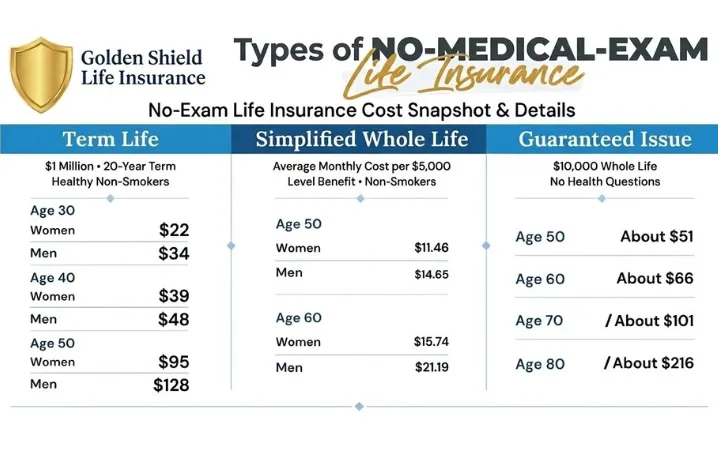
All right, section four, breaking down the costs: the financial reality. Okay, let's actually look at the numbers. This is for a $1 million, 20-year term policy for healthy non-smokers. It's surprisingly affordable. Look at this. A healthy 30-year-old woman is looking at about 22 bucks a month. A 40-year-old man, $48 a month. To secure a million dollars of tax-free protection for your family without ever seeing a doctor, for roughly the cost of a couple of streaming subscriptions. That's an absolutely incredible value.
Now, flip the script and contrast those rates with guaranteed issue whole life insurance. This is for just $10,000 in coverage. Notice how ridiculously steep this pricing curve gets as you get older. At age 50, it's about $51 a month, but by age 80, it spikes to $216 a month.
Why the huge jump? Well, the insurance company is taking on your risk completely blind. They ask zero health questions, so they essentially have to charge way more per dollar of coverage to offset that unknown risk. It's an absolutely vital tool for seniors who need final expense coverage, but you really have to understand why the cost structure works the way it does.
Smart Shopping and Advice
Which brings us to our final section, section five, smart shopping and advice: navigate like a pro. The modern online application process is incredibly streamlined into five really simple steps. One, you choose your coverage amount and type. Two, you complete a basic lifestyle and health questionnaire. Three, you basically just click a button to authorize the release of your electronic records. Four, you get your decision, often in literally minutes. And five, you add your beneficiaries and payment details. That's the whole shebang. It is fast, super easy, and totally non-invasive.
But listen, this is absolutely critical. You still have to act like a smart shopper here. Do not just blindly click and accept the very first flashy quote you see online. You really need to compare carriers. Why? Because two completely different insurance companies can look at your exact same electronic profile, your meds, your driving record, past surgeries, whatever, and offer you wildly different rates.
You've got to look beyond just that monthly premium. Check out the policy length. See what living benefit riders are included. And most importantly, especially for whole life policies, find out exactly when the full death benefit actually begins.
I love this quote from Aaron Polk. He's a former national medical underwriter and the founder of Golden Shield Life Insurance, and this really hits the nail on the head. He says, "Buy the coverage you understand, can comfortably afford, and can reasonably keep in force." It's so true. It is not just about getting the fastest approval out there so you can just check a box and move on. It's really about taking a consultative approach to finding a totally sustainable policy that is actually going to protect your family in the long term.
Final Thoughts
And that wraps up our explainer for today. The technology is finally here to secure massive financial protection using nothing but your electronic footprint, all in a matter of minutes. But you know, it really begs a much larger question. As these algorithms and our data footprints get even sharper, will the traditional medical physical soon become entirely extinct across all parts of our healthcare system? It's wild to think about. Thank you so much for joining me today, and I really hope this empowered you with the knowledge you need to get covered. See you next time.
 Aaron Polk
 founded Golden Shield Life Insurance after a 2007 accident showed him how fast a steady life can change. A former national medical underwriter and licensed independent agent, he compares no-exam coverage from multiple carriers to find what fits each health history.
Read more on LinkedIn