Hospital Indemnity Insurance
Golden Shield Life Insurance can help you compare hospital indemnity insurance quotes from available carriers to find coverage that may fit your health plan, budget, and situation.
Licensed & Reviewed
Golden Shield Life Insurance can help you compare hospital indemnity insurance quotes from available carriers to find coverage that may fit your health plan, budget, and situation.

How Hospital Insurance Pays


No cost, no obligation. We compare options from available insurance companies.
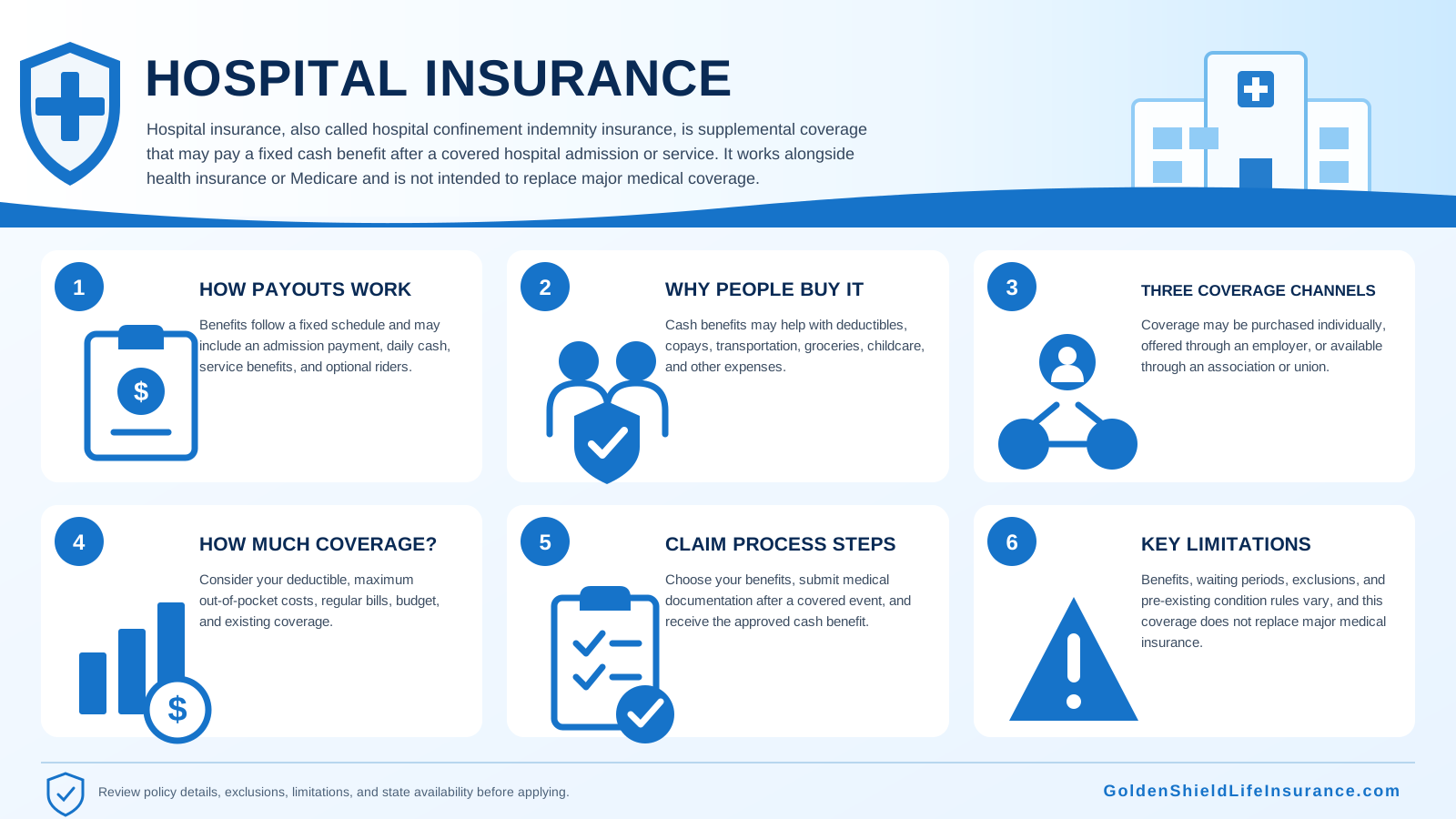
Hospital indemnity insurance is a limited, supplemental policy that may pay a predetermined cash benefit after a qualifying hospital admission, confinement, observation stay, or covered service.1 Regulators classify it as fixed indemnity coverage, which means it pays a set amount per covered event rather than reimbursing your actual medical costs.2
You may also see it called supplemental hospital insurance, hospital cash insurance, hospital stay insurance, or hospital confinement insurance. The names differ, but the idea is the same: health insurance pays your providers, and hospital indemnity insurance puts cash in your hands for the costs your health plan leaves behind.
When you apply, you choose benefit amounts from the options the carrier offers. Those amounts are written into the policy schedule. After a covered hospital event, the policy pays the scheduled amount, generally to you, whatever your health plan paid.
Suppose a policy has a $1,000 admission benefit and a $200 daily confinement benefit, and you have a covered four-day inpatient stay.
$1,000 admission + (4 days x $200) = $1,800 paid to you, regardless of what your health plan paid the hospital.
These amounts are hypothetical and are not a quote. Actual benefit options, limits, and eligibility depend on the policy you buy.
Coverage depends on the policy, but benefits commonly apply to:
Because the benefit is cash, you can use it for whatever you need: a deductible, daily copayments, rent, groceries, childcare, or travel to and from the hospital.
Hospital indemnity insurance reaches people through three different channels. Find the one that describes your situation.

You buy the policy yourself, and it may stay with you for life, subject to its terms.

Your employer offers the coverage, often through voluntary payroll deduction.

A membership-based plan offered through an association, union or professional group.
The PDFs provided on this page are Mutual of Omaha policy examples for consumer education. They do not represent every hospital insurance option available through Golden Shield Life Insurance.
Other carriers may use different benefit amounts, definitions, limitations, eligibility rules and rider names. Product and carrier availability depend on state, underwriting and applicant eligibility.
Start with the amount your current health plan could require after a hospital stay. Review:
Choose a benefit that fills a gap in your current health plan without creating a monthly payment that leaves you feeling pinched.
Make the choice based on your comfort level. A useful way to think about it is roughly an hour of your weekly income going toward this kind of coverage.
That is a starting point, not a rule. Claim eligibility and benefit triggers are determined by the policy, not by what you budget.
Hospital indemnity coverage pays a fixed amount you choose in advance, so you generally know what the benefit will be before you ever file a claim.
Select a daily or lump sum benefit, the number of covered days, and any optional riders. Available amounts vary by carrier and state.
After a qualifying hospital event, submit the claim form along with the medical documentation the carrier requests. We can help you find forms.
When the claim is approved, the policy pays the stated cash benefit, generally directly to you. Use it for medical costs, household expenses, or other needs.
Rider names, benefits and eligibility vary by insurance company and state. The descriptions below explain how these types of benefits may work.
Golden Shield Life Insurance can compare rider options from several available insurance carriers.

Benefits for qualifying emergency transportation and treatment.
May provide stated benefits for eligible ground or air ambulance transportation, emergency room treatment and urgent care visits.

An option to increase benefits at specified times.
May allow the policyowner to purchase additional benefit amounts at specified times without repeating full medical underwriting, subject to the rider's terms.

Benefits for qualifying care received at home.
May pay for eligible home health services following a qualifying illness, injury or hospital stay. Provider and prior care requirements may apply.

A stated cash benefit after a qualifying cancer diagnosis.
May pay one lump sum benefit following a covered cancer diagnosis. The rider may terminate after its benefit has been used.

Benefits for covered advanced imaging and diagnostic procedures.
May pay a stated amount for eligible diagnostic services listed in the rider, such as certain scans, imaging services or medical tests.

Benefits for qualifying surgery without an inpatient admission.
May pay a stated benefit for an eligible surgical procedure completed without an inpatient hospital confinement.

Benefits for covered rehabilitation and therapy services.
May provide benefits for qualifying physical, occupational or speech therapy, subject to visit limits and other requirements.

Stated benefits for qualifying prescription medications.
May pay scheduled benefits for eligible generic or brand name prescriptions according to the rider's terms.

Daily benefits for qualifying skilled nursing care.
May pay a daily benefit for eligible care in a qualifying skilled nursing facility following a covered event.
Optional riders normally increase the premium. Under one available plan, riders must be selected when applying and cannot be added after the policy is issued.9
The best time to review coverage is before a hospitalization is expected. Consider reviewing your options when:
Individual coverage may be available outside an employer enrollment period, subject to underwriting and state availability. Workplace and association plans may limit enrollment to certain periods or qualifying events.
Hospital indemnity insurance does not replace major medical health insurance, Medicare, Medicare Advantage, or a Medicare Supplement (Medigap) plan.4 It is one more layer for the costs those plans leave behind.
Hospital insurance may be worth considering when one covered hospital stay could create an expense that would be difficult to pay from savings.
An inexpensive policy is not automatically a good value. The benefit should solve a specific financial problem.
Premiums may depend on:
Golden Shield Life Insurance does not use producer-only rate sheets as public consumer quotes. We first review your current hospital costs, age, state and desired benefits. We can then compare qualifying illustrations from available insurance companies.
Be prepared to provide:
Do not cancel existing coverage until the new policy has been issued, reviewed and accepted.
Golden Shield Life Insurance is an independent agency, so we can compare hospital indemnity insurance quotes from available carriers and walk you through each Outline of Coverage. Request a free comparison or call (678) 884-4653.
Hospital indemnity insurance is a limited-benefit supplemental policy that pays a fixed cash amount after a covered hospital admission or stay. It works alongside your health insurance or Medicare and pays based on the policy schedule, not your hospital bill.
Generally, yes. Benefits are usually paid to the policyholder rather than to the hospital or doctor, so you can use the money for deductibles, household bills, or any other need. Check the policy for how and when claims are paid.
Yes. It is designed to work alongside health insurance and generally pays its fixed benefit no matter what your health plan pays. It does not replace major medical coverage, and you should keep your health plan in place.
An inpatient stay for a covered surgery may trigger admission and daily benefits. Outpatient surgery is usually covered only if the policy includes an outpatient surgery benefit or rider. Benefit amounts and definitions vary by policy.
Some policies pay admission and daily benefits for childbirth, but others exclude it or apply a waiting period. Coverage generally must be in force before the pregnancy, so review the policy's maternity terms before you apply.
No. Medicare does not pay for hospital indemnity insurance, and it is not a Medicare supplement policy. Some Medicare beneficiaries, especially those with Medicare Advantage hospital copayments, buy it separately to help with out-of-pocket costs.
It depends on the policy. Many policies pay mainly for inpatient admissions, and observation status may be treated differently. Emergency room and urgent care benefits are often available through an optional rider.
Premiums depend on your age, state, the benefit amounts you choose, the number of covered days, riders, and whether you cover yourself or your household. A licensed broker can compare actual quotes from available carriers.
Tell us a little about your situation and a licensed agent will compare hospital insurance options from available carriers.
Hospital indemnity insurance provides limited benefits. It is supplemental coverage and is not a substitute for major medical insurance, Medicare, Medicare Advantage or Medicare supplement insurance. Coverage is subject to exclusions, limitations, waiting periods and underwriting approval, and availability varies by state.
A short walkthrough of the costs a hospital stay leaves behind, how a cash benefit works, and how to decide whether the coverage fits your situation.
Watch on YouTube · Hospital insurance provides limited benefits. Coverage, benefit amounts and eligibility vary by carrier, policy and state.
Welcome to this explainer. Today we are unpacking a topic that catches a lot of people off guard: the financial realities of a medical emergency. When a health crisis hits, we naturally focus on recovery, doctors and treatment. But there is a separate financial gap that opens up underneath all of that, and this video is about how to bridge it.
Who pays your rent while you are in the hospital? Most of us assume our health insurance has it covered. Major medical insurance is there to pay your doctors and the facility for your care, but everyday life does not pause. The landlord still wants rent. The mortgage company still wants its check. The grocery bills do not stop.
Some of these costs are expected. Medical deductibles and copayments are the obvious ones. But you also still have rent or a mortgage, utilities, and groceries for your family. If you are hospitalized, someone has to watch the kids, which can mean paying for childcare or home assistance. There is transportation, and even the parking fees your family pays to visit you.
Nonmedical bills like these are a significant contributor to financial stress during a health crisis. Even with strong primary health insurance, daily living costs pile up quickly.
Aaron Polk is a licensed agent who turned down supplemental coverage. He thought he would be fine keeping only his primary health insurance. Then he spent eight months in a hospital room, with no income coming in and every bill still due. He went home to more recovery costs. It is a real world example of what happens when that financial gap is left open.
Health insurance pays the hospital and the doctors for your medical care. Hospital insurance, also known as hospital indemnity insurance, generally pays you directly in cash. The money does not go to the facility. It goes to you, so it can be used for rent, groceries, a deductible, or whatever else you need.
Formally, hospital indemnity coverage is a limited supplemental policy that may pay a predetermined cash benefit following a qualifying hospital admission or covered service. The crucial word is supplemental. It is not a substitute for major medical insurance, it is not Medicare, and it is not a Medigap plan. It is a separate policy that sits alongside your primary health coverage.
These benefits are schedule based. Payouts are determined by the policy you choose in advance, independent of what your health plan pays or how large your actual hospital bill is. It could be a single lump sum for being admitted, a fixed daily cash amount for each day of a covered stay, a stated benefit for specific services, or a combination of an admission benefit and a daily benefit. You generally know what the benefit will be before you ever file a claim.
Getting access to that cash happens in three steps. First, you choose your benefits up front, deciding on daily or lump sum amounts. Second, after a qualifying hospital event, you submit your claim along with the required medical documentation. Third, once the claim is approved, the benefit is generally paid directly to you.
While the core policy covers inpatient hospital stays, optional riders can extend the coverage. There are riders for ambulance, emergency room and urgent care visits. There is home health care to help pay for support once you leave the hospital, and a lump sum cancer rider that may pay out on a qualifying diagnosis. There are also options for outpatient surgery, therapy and prescription drugs. Riders let you build a policy that matches your own situation.
One strategic note. Adding riders increases your premium, and under some plans they must be selected when you first apply. You generally cannot add them later, so it pays to plan ahead.
An inexpensive policy is not automatically a good value unless it solves a specific financial problem. This coverage tends to be most useful when your primary health plan has a high deductible, when your emergency savings are limited, or when your household depends heavily on one income.
It provides less value if your savings can comfortably absorb the cost, or if your primary coverage already leaves you with limited cost sharing. Match the benefit to your actual gap.
Timing matters. The best time to review these options is before a hospitalization is expected, particularly during major life transitions. Consider looking at hospital indemnity insurance if you are moving to a high deductible plan, becoming self-employed, changing jobs, joining or leaving Medicare Advantage, approaching retirement, or adding a spouse to your plan.
A useful rule of thumb is roughly an hour of your weekly income going toward this kind of coverage. It is a starting point rather than a hard rule, but it is a helpful mental model. It helps you choose a benefit that fills the gap in your health plan without creating a monthly premium that leaves you feeling pinched.
If a hospital stay stopped your income today, how long would your savings last? It is a difficult question, but it deserves an honest look. If the answer makes you uncomfortable, it may be time to look at bridging that gap.

Aaron Polk
Founder, Golden Shield Life Insurance · Former National Medical Underwriter and Licensed Life Insurance Broker · NPN 21216745 · Georgia Agency License 242517
Aaron once turned down supplemental coverage and kept only health insurance, without understanding what he was leaving on the table. He spent eight months in a hospital room with no income coming in and every bill still due, then went home to more costs. Hospital insurance is the policy he is most glad to help families with, because of how much it can do when a household needs it most.
Last reviewed: November 2026. This page is reviewed and updated as products, carrier filings, and state requirements change.